
MVHR filters


-
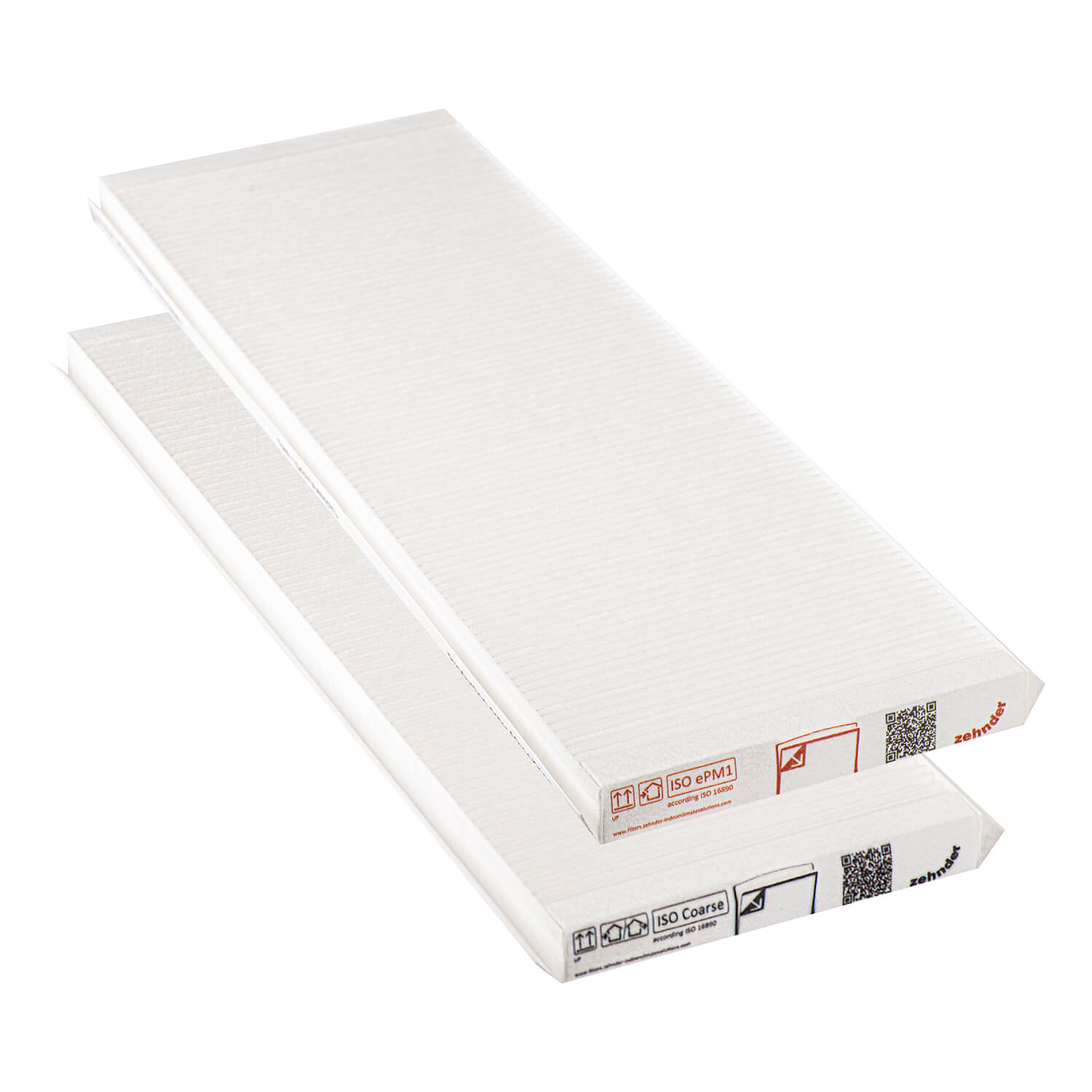 OriginalExtract filter size: 500x160x23 mmSupply filter size: 500x160x23 mmFilter class (EN779): G4+F7Filter quantity in a set: 2 filtersProtection level
Filter protection level indicates efficiency in blocking particles or contaminants, varying by standard and application.
BasicGeneral dust and particle filtration
Pollen and moldCaptures pollen, mold spores, and other allergens
Smog and bacteriaProtects against allergens and urban pollution
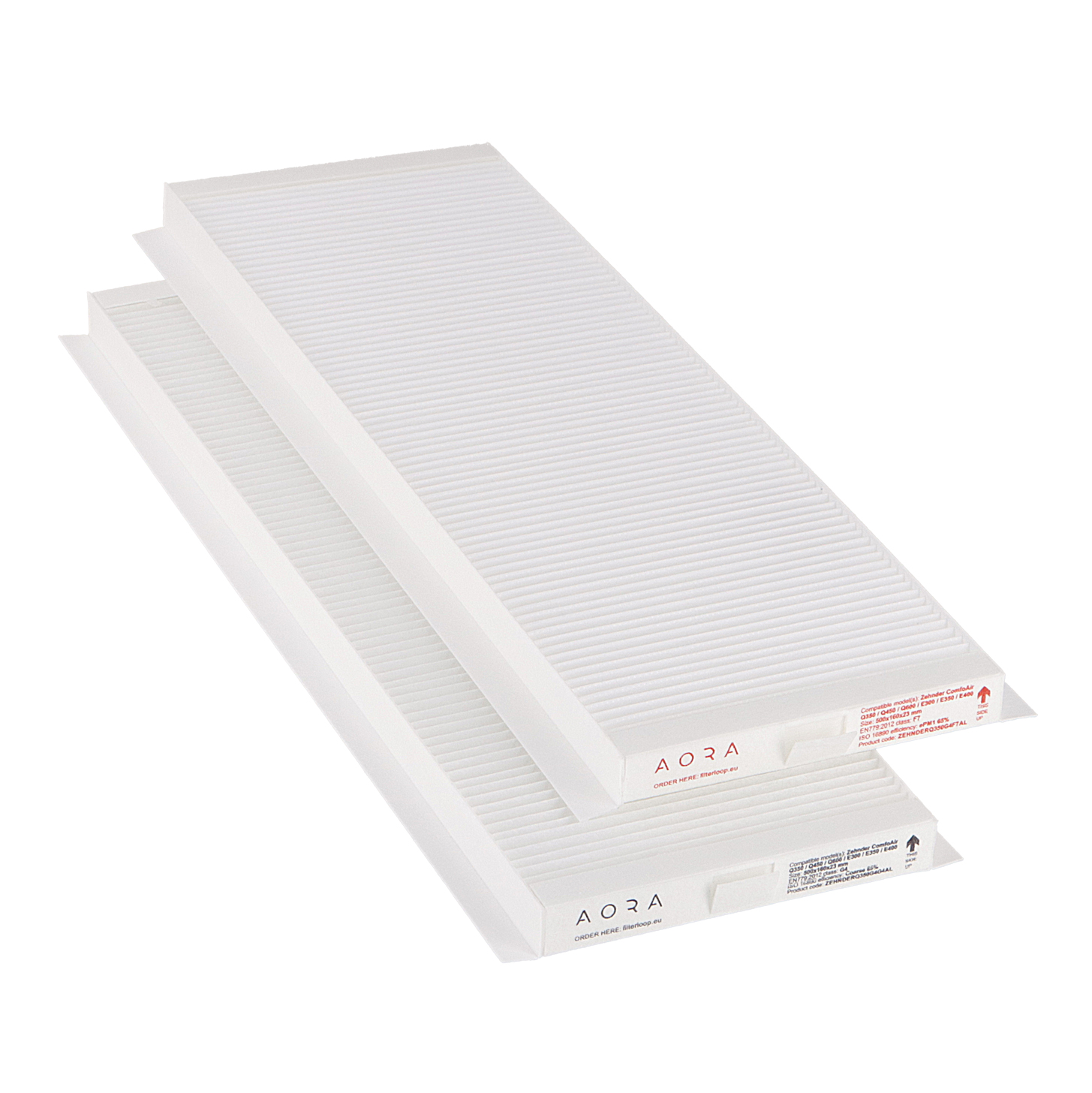 House brandExtract filter size: 500x160x23 mmSupply filter size: 500x160x23 mmFilter class (EN779): G4+F7Filter quantity in a set: 2 filtersProtection level
Filter protection level indicates efficiency in blocking particles or contaminants, varying by standard and application.
BasicGeneral dust and particle filtration
Pollen and moldCaptures pollen, mold spores, and other allergens
Smog and bacteriaProtects against allergens and urban pollution
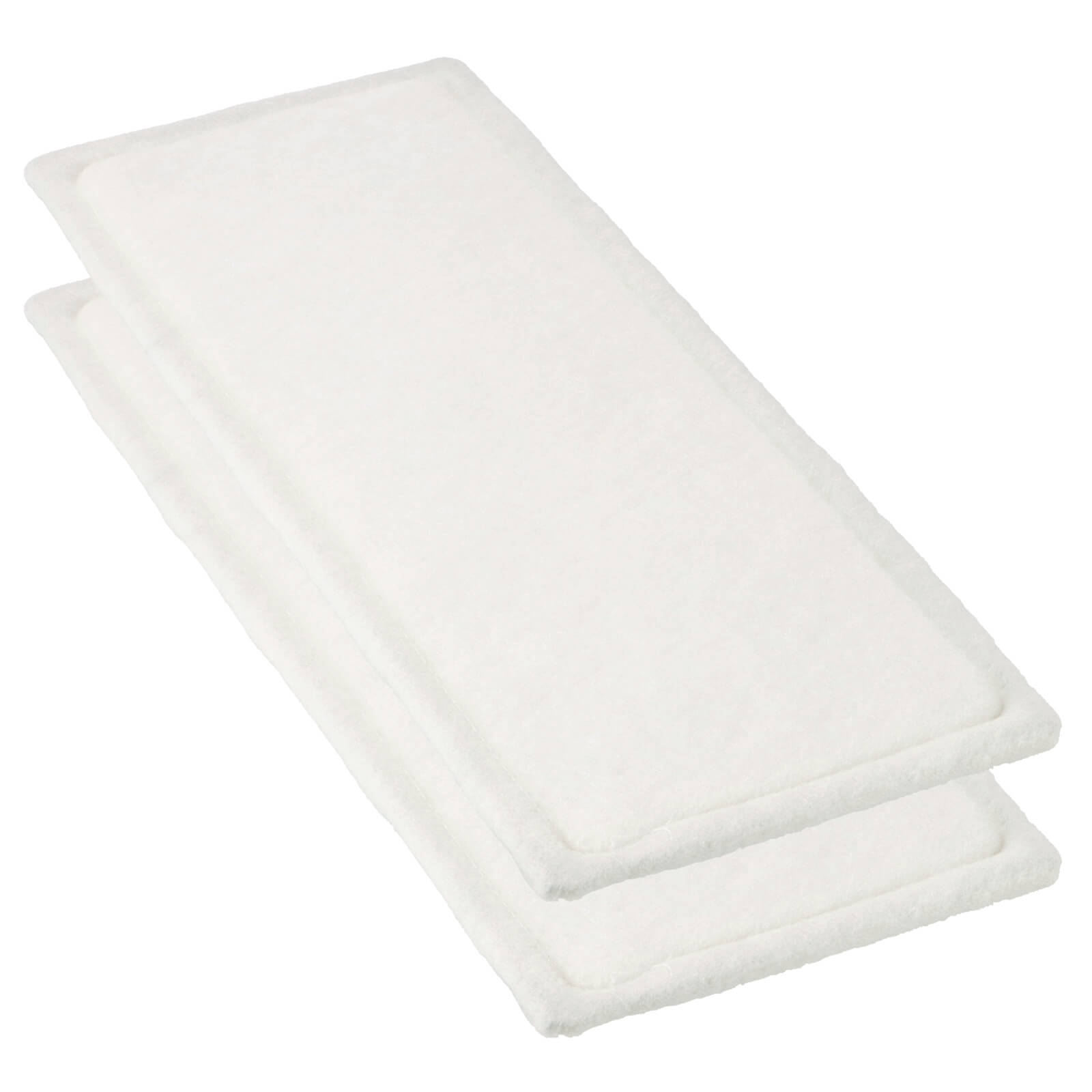 House brandExtract filter size: 525x185x5 mmSupply filter size: 525x185x5 mmFilter class (EN779): G4+G4Filter quantity in a set: 2 filtersProtection level
Filter protection level indicates efficiency in blocking particles or contaminants, varying by standard and application.
BasicGeneral dust and particle filtration
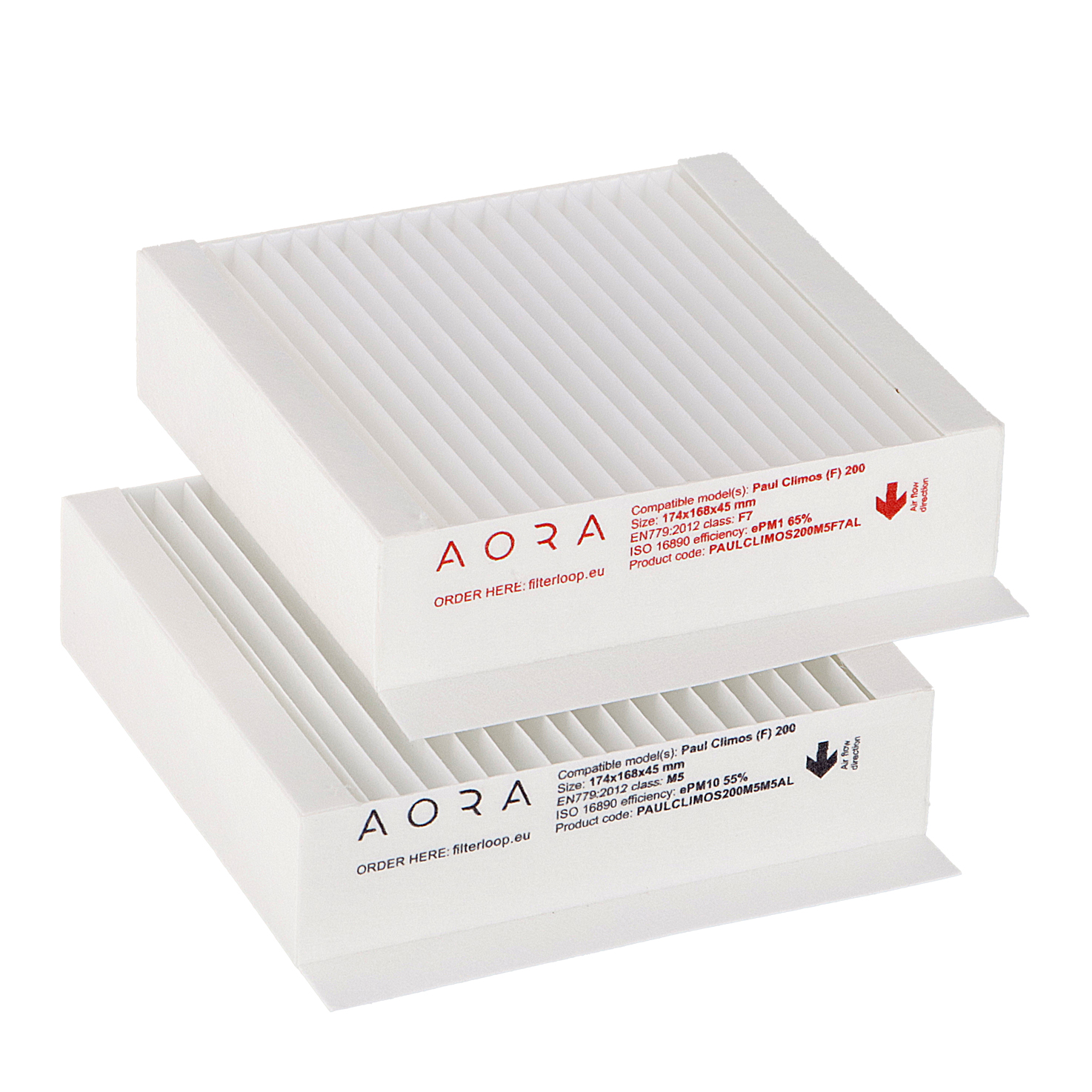 House brandExtract filter size: 174x168x45 mmSupply filter size: 174x168x45 mmFilter class (EN779): M5+F7Filter quantity in a set: 2 filtersProtection level
Filter protection level indicates efficiency in blocking particles or contaminants, varying by standard and application.
BasicGeneral dust and particle filtration
Pollen and moldCaptures pollen, mold spores, and other allergens
Smog and bacteriaProtects against allergens and urban pollution
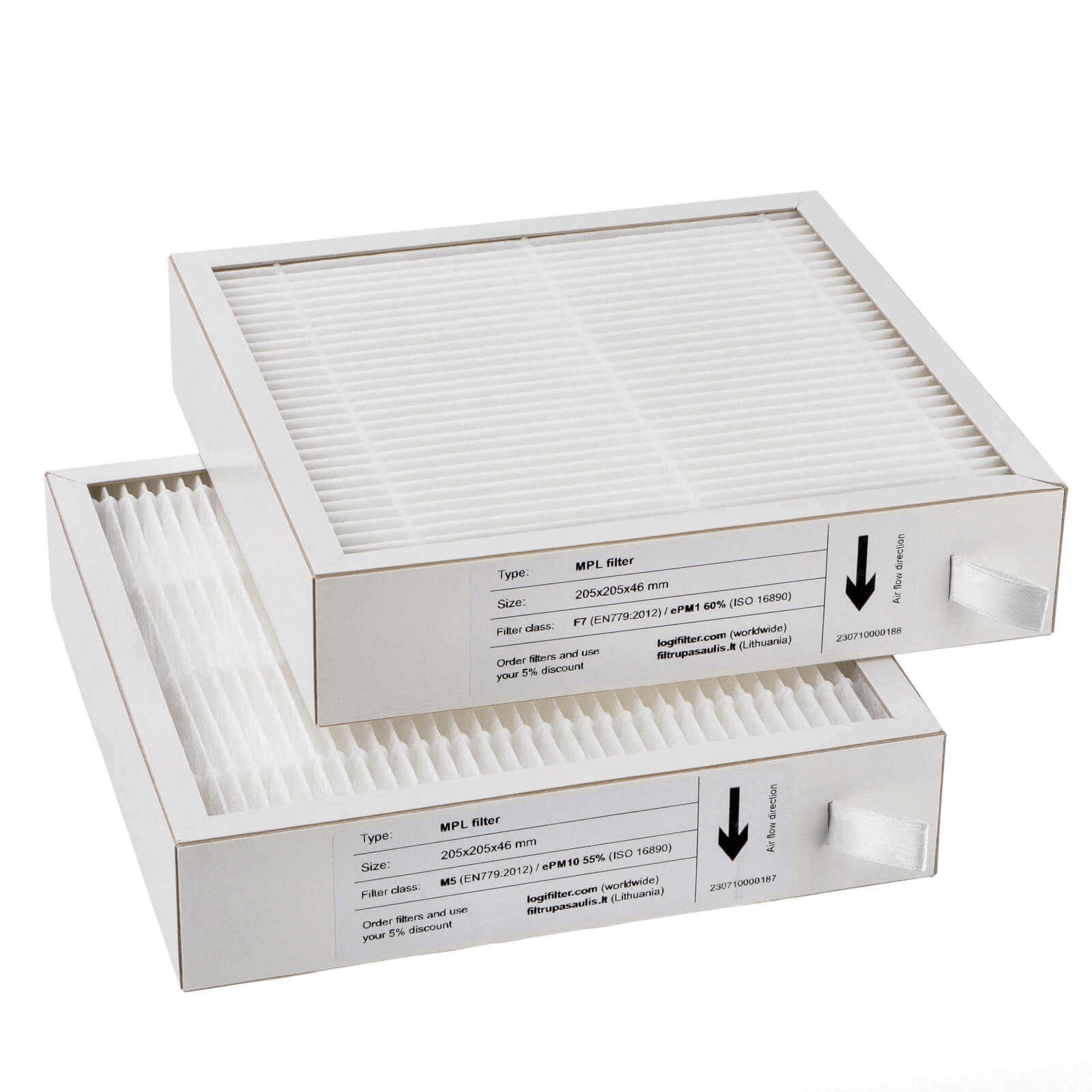 House brandExtract filter size: 205x205x46 mmSupply filter size: 205x205x46 mmFilter class (EN779): M5+F7Filter quantity in a set: 2 filtersProtection level
Filter protection level indicates efficiency in blocking particles or contaminants, varying by standard and application.
BasicGeneral dust and particle filtration
Pollen and moldCaptures pollen, mold spores, and other allergens
Smog and bacteriaProtects against allergens and urban pollution
 House brandExtract filter size: 216x199x22 mmSupply filter size: 216x199x22 mmSupply filter size 2: 216x199x48 mmFilter class (EN779): G4+G4+F7Filter quantity in a set: 3 filtersProtection level
Filter protection level indicates efficiency in blocking particles or contaminants, varying by standard and application.
BasicGeneral dust and particle filtration
Pollen and moldCaptures pollen, mold spores, and other allergens
Smog and bacteriaProtects against allergens and urban pollution
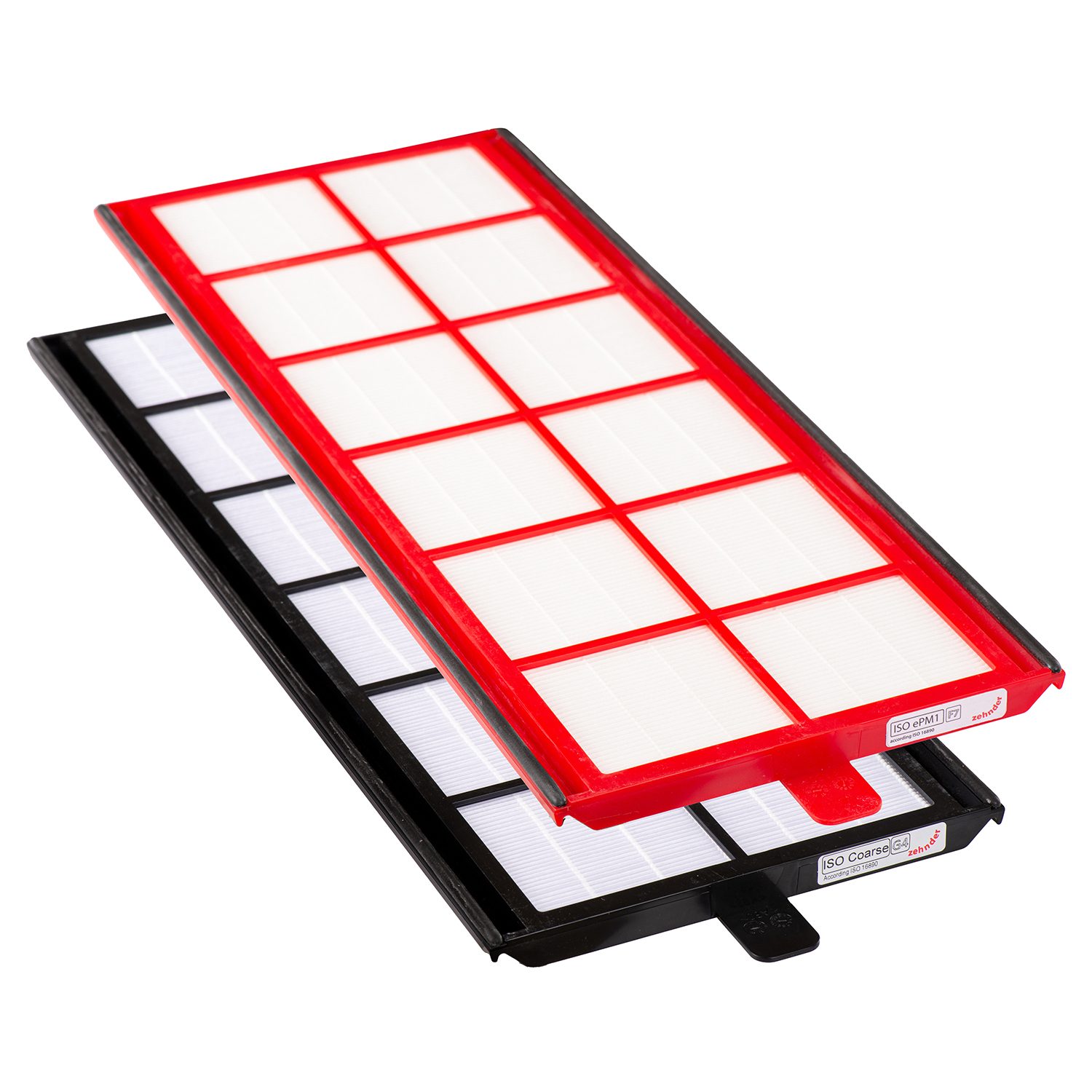 OriginalExtract filter size: 500x197x16.5 mmSupply filter size: 500x197x16.5 mmFilter class (EN779): G4+F7Filter quantity in a set: 2 filtersProtection level
Filter protection level indicates efficiency in blocking particles or contaminants, varying by standard and application.
BasicGeneral dust and particle filtration
Pollen and moldCaptures pollen, mold spores, and other allergens
Smog and bacteriaProtects against allergens and urban pollution
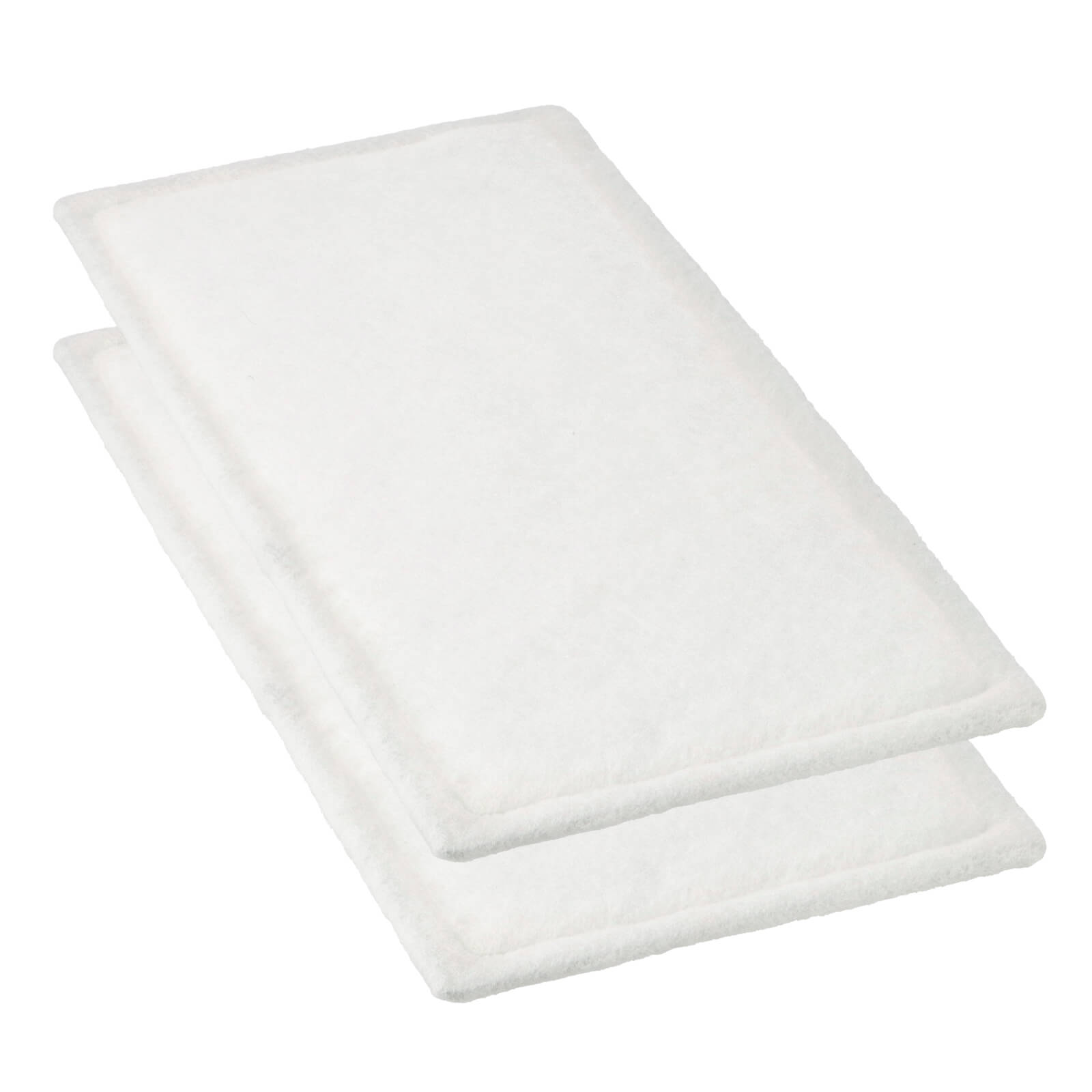 House brandExtract filter size: 510x245x5 mmSupply filter size: 510x245x5 mmFilter class (EN779): G4+G4Filter quantity in a set: 2 filtersProtection level
Filter protection level indicates efficiency in blocking particles or contaminants, varying by standard and application.
BasicGeneral dust and particle filtration
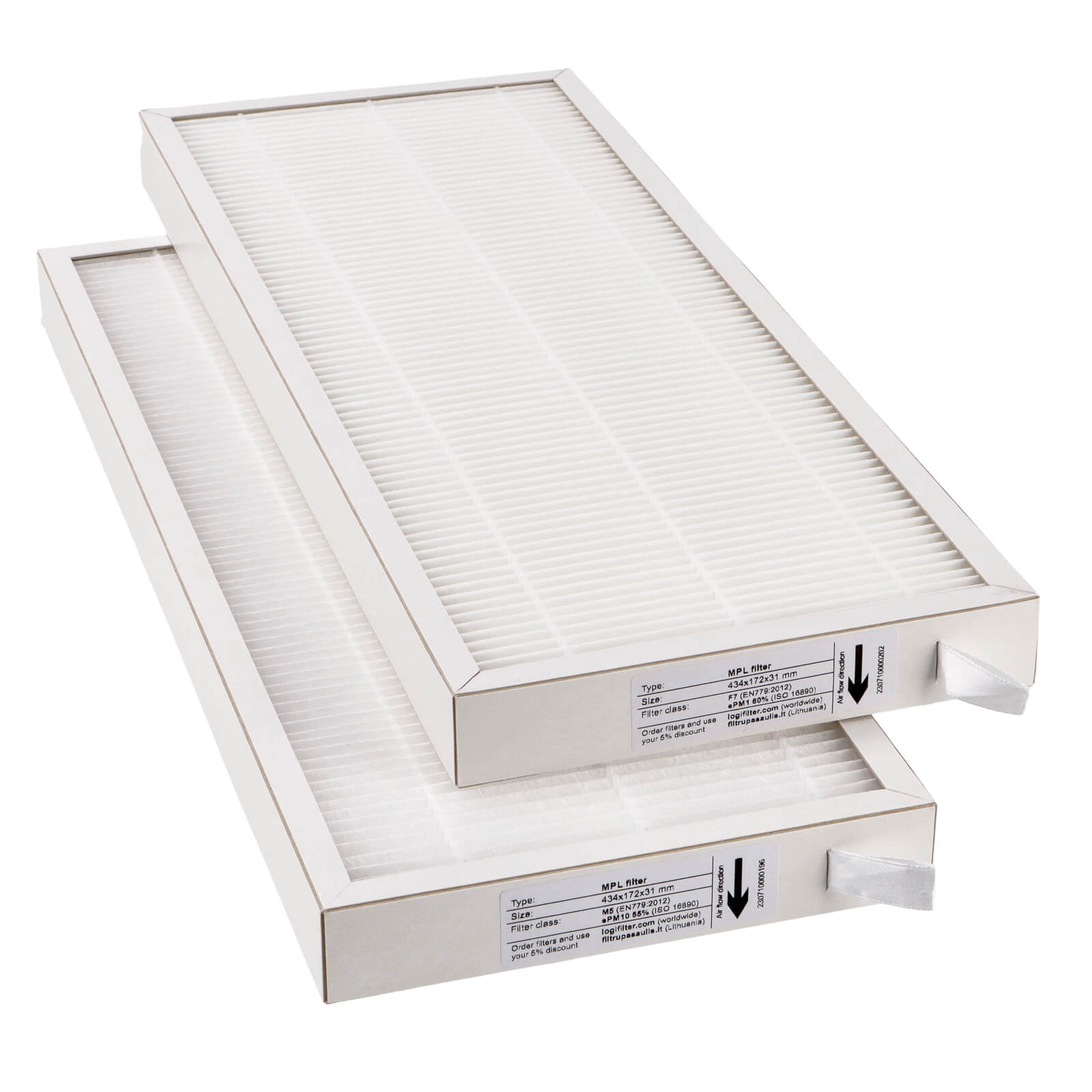 House brandExtract filter size: 434x172x31 mmSupply filter size: 434x172x31 mmFilter class (EN779): M5+F7Filter quantity in a set: 2 filtersProtection level
Filter protection level indicates efficiency in blocking particles or contaminants, varying by standard and application.
BasicGeneral dust and particle filtration
Pollen and moldCaptures pollen, mold spores, and other allergens
Smog and bacteriaProtects against allergens and urban pollution
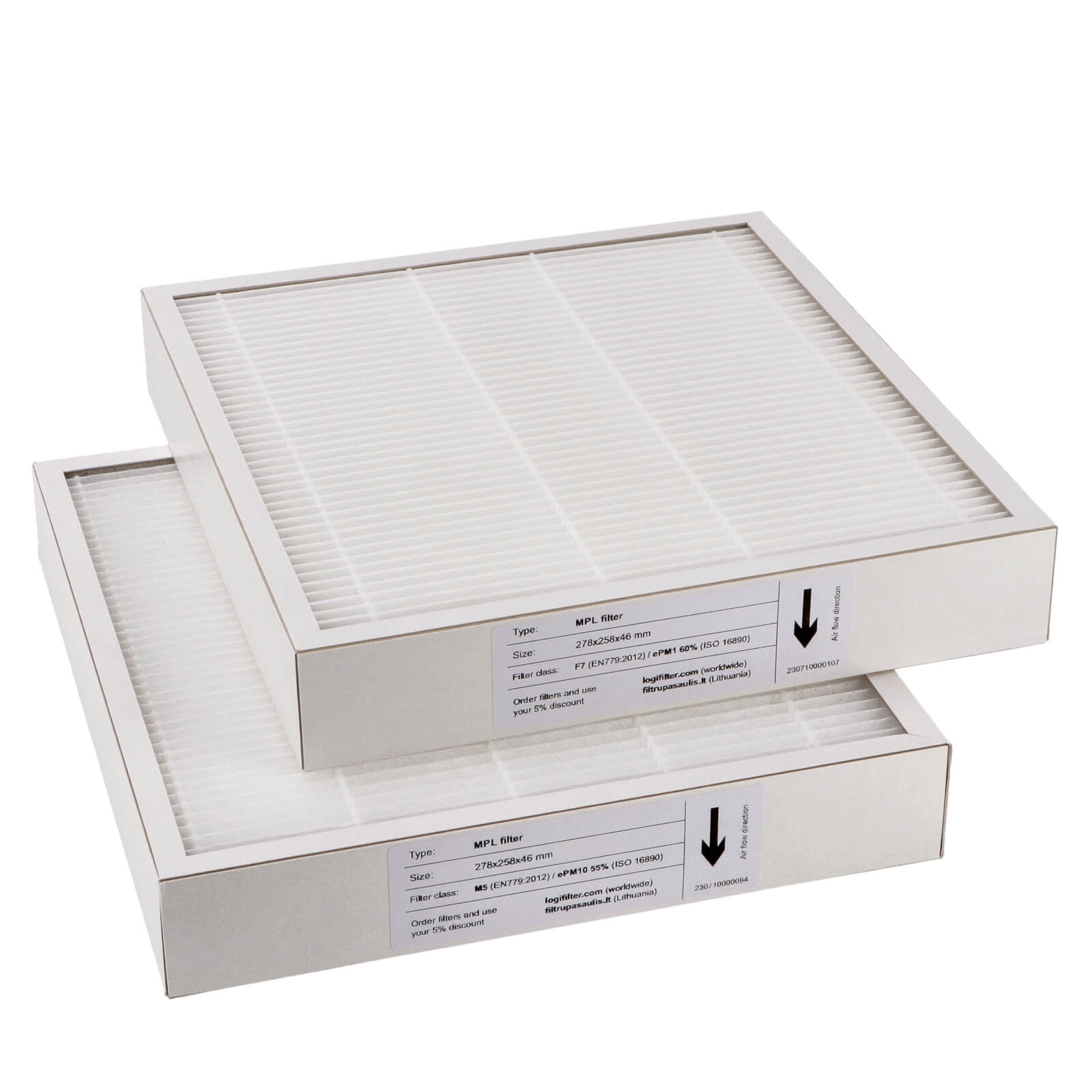 House brandExtract filter size: 278x258x46 mmSupply filter size: 278x258x46 mmFilter class (EN779): M5+F7Filter quantity in a set: 2 filtersProtection level
Filter protection level indicates efficiency in blocking particles or contaminants, varying by standard and application.
BasicGeneral dust and particle filtration
Pollen and moldCaptures pollen, mold spores, and other allergens
Smog and bacteriaProtects against allergens and urban pollution
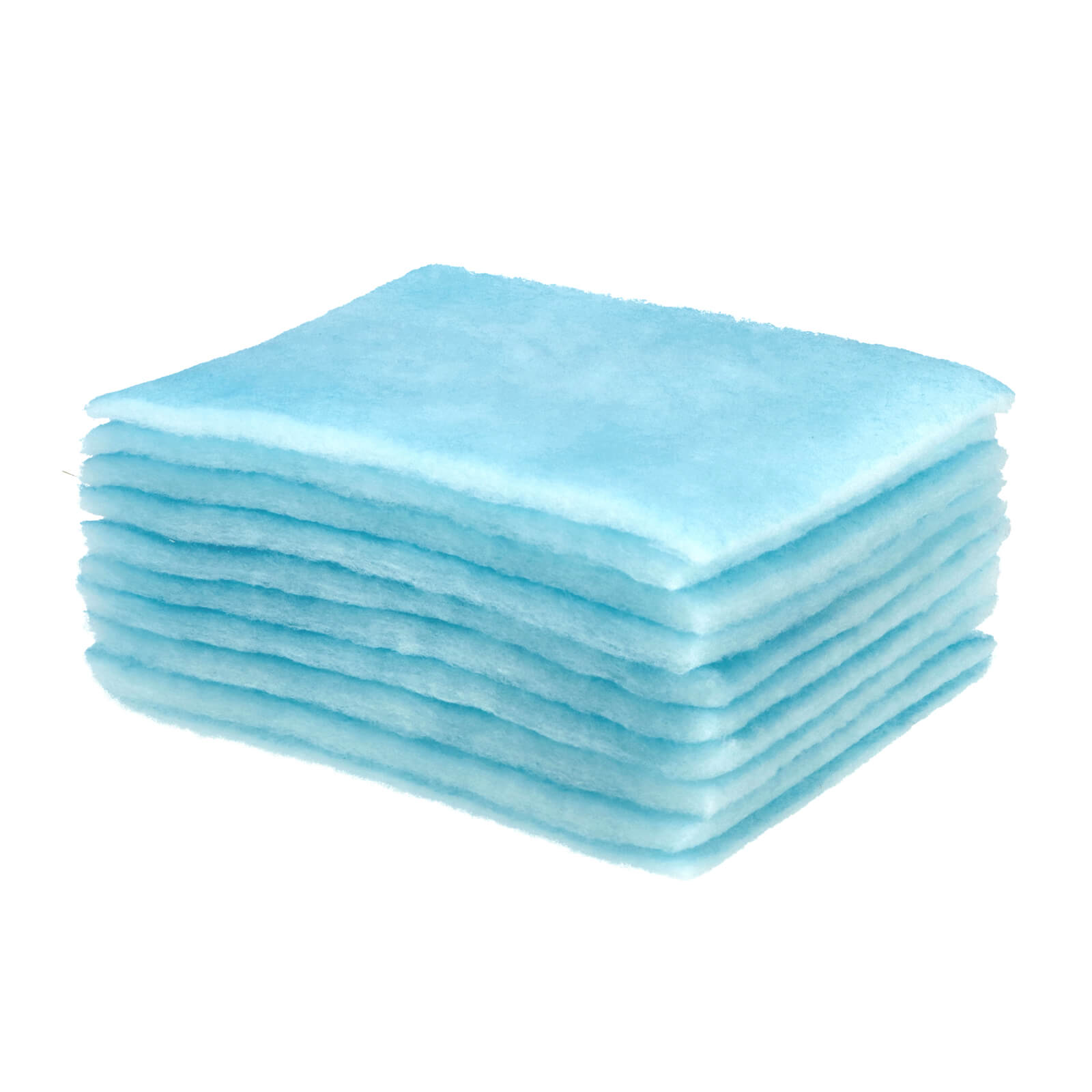 OriginalExtract filter size: 300x230x10 mmSupply filter size: 300x230x10 mmFilter class (EN779): G4Filter quantity in a set: 10 filtersProtection level
Filter protection level indicates efficiency in blocking particles or contaminants, varying by standard and application.
BasicGeneral dust and particle filtration
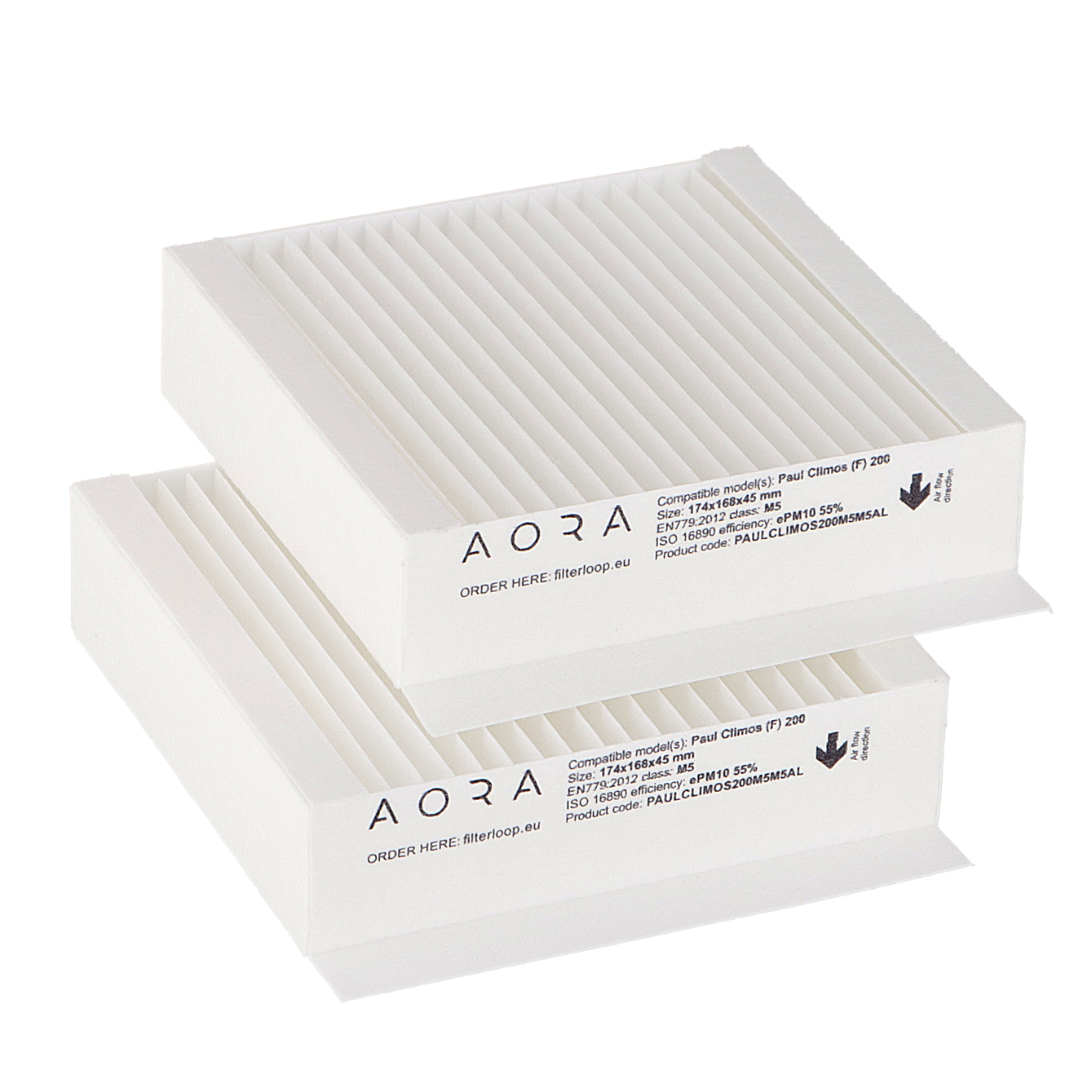 House brandExtract filter size: 174x168x45 mmSupply filter size: 174x168x45 mmFilter class (EN779): M5+M5Filter quantity in a set: 2 filtersProtection level
Filter protection level indicates efficiency in blocking particles or contaminants, varying by standard and application.
BasicGeneral dust and particle filtration
Pollen and moldCaptures pollen, mold spores, and other allergens
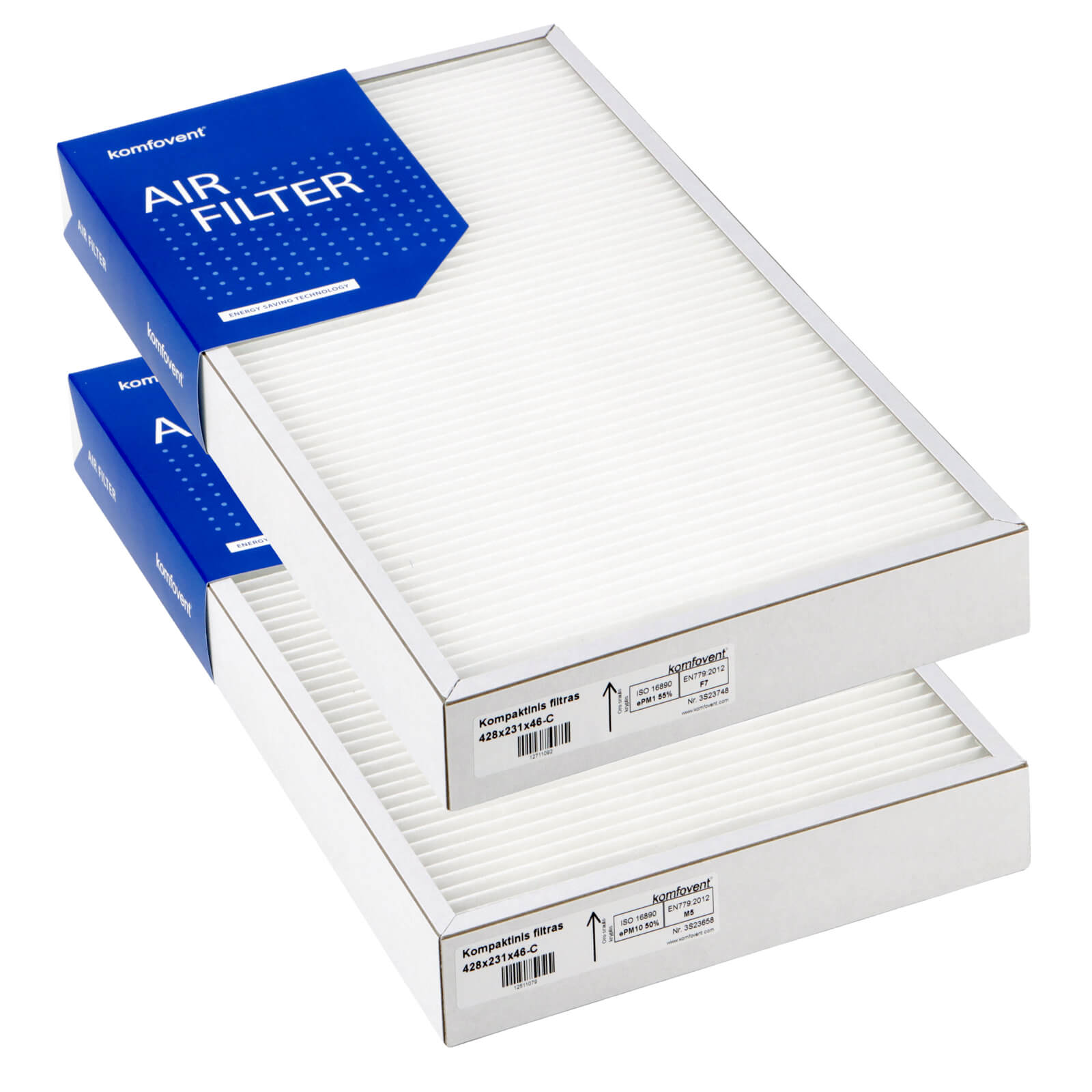 OriginalExtract filter size: 428x231x46 mmSupply filter size: 428x231x46 mmFilter class (EN779): M5+F7Filter quantity in a set: 2 filtersProtection level
Filter protection level indicates efficiency in blocking particles or contaminants, varying by standard and application.
BasicGeneral dust and particle filtration
Pollen and moldCaptures pollen, mold spores, and other allergens
Smog and bacteriaProtects against allergens and urban pollution
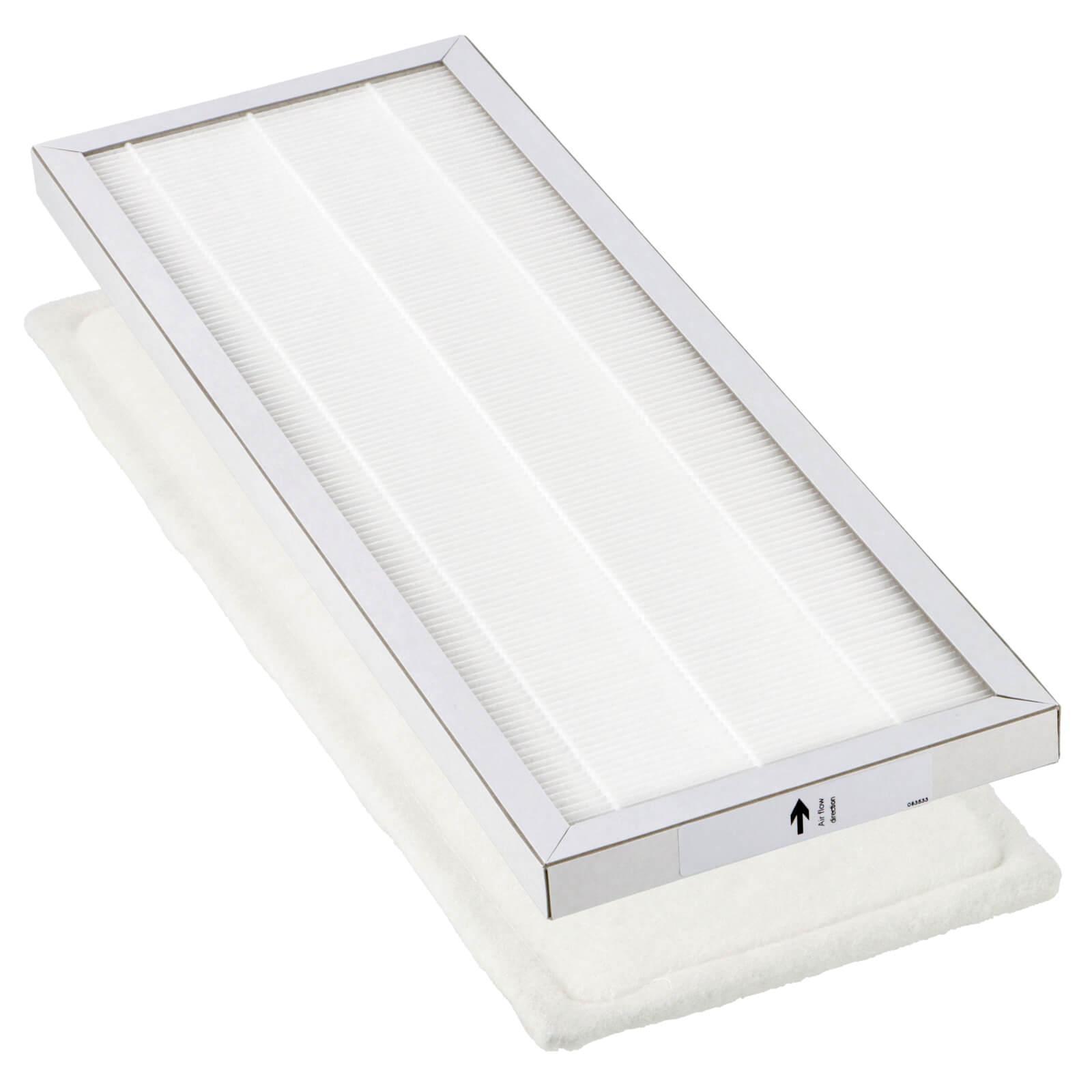 House brandExtract filter size: 525x185x5 mmSupply filter size: 525x185x24 mmFilter class (EN779): G4+F7Filter quantity in a set: 2 filtersProtection level
Filter protection level indicates efficiency in blocking particles or contaminants, varying by standard and application.
BasicGeneral dust and particle filtration
Pollen and moldCaptures pollen, mold spores, and other allergens
Smog and bacteriaProtects against allergens and urban pollution
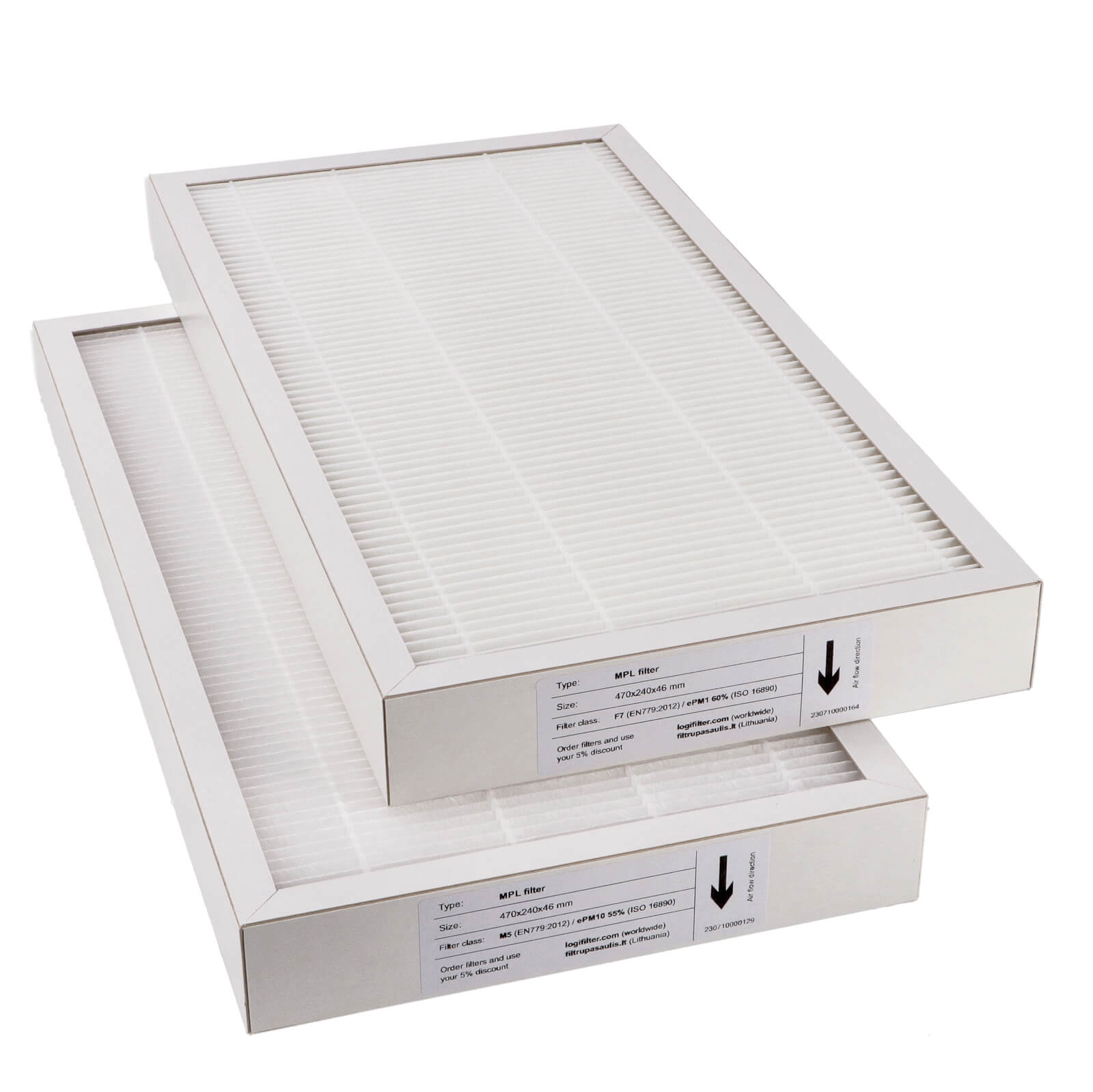 House brandExtract filter size: 470x240x46 mmSupply filter size: 470x240x46 mmFilter class (EN779): M5+F7Filter quantity in a set: 2 filtersProtection level
Filter protection level indicates efficiency in blocking particles or contaminants, varying by standard and application.
BasicGeneral dust and particle filtration
Pollen and moldCaptures pollen, mold spores, and other allergens
Smog and bacteriaProtects against allergens and urban pollution
1-15 of 492High-quality replacement filters for all major MVHR ventilation systems
We offer a wide selection of high-performance replacement filters for all major ventilation brands.
What are MVHR filters, and why are they important?
MVHR (Mechanical Ventilation with Heat Recovery) systems work by continuously extracting stale, humid, or polluted air from indoor spaces and supplying fresh, filtered air from outside. As this exchange happens, a built-in heat exchanger recovers heat from the outgoing air and transfers it to the incoming air – without the two airflows ever mixing. This process improves indoor air quality while also cutting down on energy loss and heating costs.
Types of filters in our offer
We stock both original filters and high-quality house brand alternatives – both made in the EU with high-quality materials, under strict ISO 16890 standards to ensure high filtration performance and reliability.
Available filter options in our offer are:
- G4 and G3 filters on the extract or supply side: ideal for capturing larger particles like soil particles, large pollen grains, plant debris, insect wings, sawdust, sand and textile lint.
- M5 filters on the extract or supply side: ideal for capturing larger particles like pollen, mould spores, pet dander, and house dust.
- M6 and F7 filters on the supply side: high-efficiency filters that capture very fine particles, including pollen, pet dander, bacteria, smog, tobacco smoke particles, combustion dust, spores, and wildfire smoke particles.
Still not sure which filter fits your device?
Our website helps you filter by brand and model series, so you can quickly find what you need. If you’re still unsure, visit our FAQ section for help identifying your unit, or reach out to our support team.
Customer Reviews
 The experience was seamless, they communicated well, and I got what I ordered quickly. I also found a product that I didn’t know existed, and ordered it as well. All in all, an excellent experience!Steve Schafer
Trustpilot review
Top, fast shipment, good productTim SoenenTrustpilot review
Get what I ordered, cheaper than in my country (post service included).MatejTrustpilot review
Very good service! A pleasant shopping experience.Peter PostruznikTrustpilot review
Everything was ok but it took like a week to receive the order when it appeared as completed in the status. Maybe more reliable information on the delivery process would be appreciated.Toni AlmansaTrustpilot review
Most important: No fake shop 🙂 (i wos looking for an impressum and country of operating headquarters). Summary: Fast delivery. Moderate price. Good Quality. Quick and easy purchase. Good online-Shop.Hans-dieter TinhofTrustpilot review
Very good product and good priceCARLOS MARTINSTrustpilot review
Need Help? Start Here.
We’ve gathered answers to the most common questions about our products and services. If you can’t find an answer here, please contact us directly.
How do I know which filters fit my Airobot unit?
Check the model name on the unit's rating label. We stock original M5+F7 filter sets for the Airobot L, L5, S1/S2, V3 and V8, and each model takes its own size — for example, the L set measures 269×236×46 mm and the L5 set 305×248×92 mm. If the label has worn off, measure the length, width and depth of your current filters in millimetres and match them against the dimensions on each product page.
Does a dirty filter affect my Airobot’s smart sensors?
Yes. Airobot's demand-controlled algorithm relies on stable airflow readings to interpret its CO2 and humidity sensors correctly. A clogged filter reduces airflow and can cause the system to run at higher fan speeds than necessary, increasing both noise and energy use — replacing filters on schedule keeps the smart control logic accurate.
What filter class does an Airobot system typically use?
Every Airobot filter set we stock — for the L, L5, S1/S2, V3 and V8 — uses the same two-stage combination:
- Extract side — M5 filter
- Supply side — finer F7 (ePM1) filter
Airobot units adjust airflow automatically from their CO2 and humidity readings, so filters can load up faster during busy periods such as parties, cooking or humid weather. Check them a little more often than the usual 3–6 month interval at those times.
Are the Airobot filters you sell original?
Yes. All the Airobot filter sets we stock are original M5+F7 sets for the L, L5, S1/S2, V3 and V8, so the size and filter class match what the unit was supplied with. Ordering two or more sets at once gives you a bulk discount, which makes it easy to keep a spare set at home for the next change.
How quickly can I get Airobot filters delivered in Finland?
In-stock Airobot filters are dispatched within 1–2 business days and travel with DHL, DPD, GLS, SmartPost or Omniva, so you can have them delivered to a parcel locker as well as to your door. Delivery is free on orders over €150, which is why many customers order two sets at once and keep the spare at home; only clearly marked made-to-order items take 5–10 business days. Because an Airobot unit regulates its airflow from live CO2 and humidity readings, its filter prompt can arrive earlier than a fixed date — ordering when it first appears means the unit never runs on a saturated filter while the parcel is in transit.
Can I wash and reuse my Airobot filters?
No. The pleated M5 and F7 filters in Airobot units are not designed to be washed or vacuumed. Water and suction damage the filter media and loosen the dust it has already trapped, so a cleaned filter lets more fine particles through and can restrict airflow unevenly. Replace both filters as a set instead.
How often should Duplex filter cartridges be replaced?
Atrea's guidance for Duplex filters covers three checkpoints:
- Check filters every 3 months
- Replace them at least twice a year, even if they still look clean
- Watch for the RD5/RD6 controller's on-screen maintenance reminder, which triggers once pressure drop across the filter rises
Following that on-screen prompt rather than a fixed calendar date gives the most accurate result for your specific air quality conditions.
Which Atrea units are covered by your filter range?
We stock original filters for the Atrea Duplex range, including Duplex EC5/ECV5, Easy, Easy2, Pro, Pro-V and Slim units. Filters for the EC5/ECV5 and Easy models come in packs of 10 of one class (G4 or F7), while Easy2, Pro, Pro-V and Slim filters come as sets of two. If you know your unit is a Duplex but are unsure of the exact variant, measure the length, width and depth of the current filter in millimetres and match it on the product page.
Why are some Atrea Duplex filters sold in packs of 10?
Duplex EC5/ECV5 and Duplex Easy units use single filters, and Atrea supplies them in packs of 10 pieces of one class — G4 or F7. A pack covers several replacements, so check how many filters your unit takes and order G4 and F7 packs separately if you run a different class on each side. Newer models such as Duplex Pro, Pro-V and Easy2 use matched sets of two filters instead.
Can I upgrade my Atrea filter class for better allergen protection?
On most Duplex models, yes. Atrea filters come in two classes: G4 for coarse dust and F7 (ePM1) for fine dust and pollen. For most EC5/ECV5, Easy, Easy2, Pro and Pro-V sizes we stock both classes in the same size, so you can switch from G4 to F7 without any modification — one of the simplest upgrades for households with pollen or dust allergies. A few compact models, such as the Duplex Slim 150, Easy2 200 and Pro-V 160, are available in G4 only.
Which supply air filter class does Finnish guidance expect for my Atrea Duplex?
For living spaces in continuous use, Finnish design guidance applies supply air class SUP 2, and in normal outdoor air conditions (ODA 1) that translates into an ePM1 50% filter on the supply side — the class that used to be called F7. On the extract side a coarser class is enough, since its job is to protect the heat exchanger and ducts rather than to clean the air you breathe. For a Duplex unit the practical rule follows from this: keep the supply filter at the class the system was designed around. Dropping a step to save money changes what actually reaches your rooms, which is the one thing the class is there to control.
What happens if the Atrea filter I order doesn’t fit my Duplex unit?
If a filter you've ordered turns out not to match your Duplex variant, we accept returns or exchanges as long as the filter is unused and in its original packaging. Sending us your exact Duplex model code or the measured filter dimensions upfront is the easiest way to avoid a mismatch in the first place.
How do I identify the correct filter for my Blauberg unit?
Blauberg produces a broad range of ventilation units, so start with the model code on the unit's rating plate. We stock filter sets for the Blauberg Komfort range — including Komfort EC SB, EC S5B, EC DB, D5B180E, SBE 250E and the Komfort Roto EC models. If the plate is missing, measure your current filters in millimetres to narrow it down in our catalogue.
What filter grade comes standard with Blauberg units?
The Blauberg Komfort filter sets we stock use a G4 filter on the extract side and an F7 (ePM1) filter on the supply side. G4 protects the heat exchanger from coarse dust, while F7 captures fine dust and pollen before the air reaches your rooms.
Why might two Blauberg units with a similar name need different filters?
Blauberg uses similar model names across many sizes and versions — for example Komfort EC SB 250E, SB 350 and SB 550, or Roto EC SE 200 to SE 600 — and each size takes its own filter set. If a replacement doesn't fit despite a similar name, compare the full model code and measure the physical filter dimensions rather than relying on the series name alone.
How much can I save buying compatible Blauberg filters instead of manufacturer-branded originals?
Our ISO 16890-certified compatible filters for Blauberg units are generally priced well below manufacturer-branded originals, since you're not paying a premium for brand packaging. Filtration class, dimensions and airflow performance remain matched to the OEM specification, so the savings don't come at the cost of air quality.
Do I need any tools or a technician to replace filters in a Blauberg unit myself?
No — most Blauberg residential units are designed for tool-free filter access:
- Open the front or side panel by hand
- Slide the old filter out
- Slide the new filter in and close the panel
The whole process typically takes a few minutes and doesn't require an installer visit.
Why do my Blauberg filters get dirty so fast in spring?
Almost certainly katupöly — the street dust season. Through the winter, studded and friction tyres grind asphalt and spread sanding grit, and when the roads dry out in spring all of it becomes airborne. During the worst spring dust episodes the daily PM10 concentration in urban air can rise to more than ten times the average level, and the supply filter takes that load. In practice this means a Blauberg unit in a town or near a main road can go through a filter far faster in March–May than the calendar interval suggests. Check the filters during the dust season rather than waiting, and plan the spring change for after it has passed.
Which Brink ventilation series do you supply filters for?
We carry replacement filter sets for Brink's most common residential lines:
- Flair (225, 325/400, 450/600)
- Renovent Excellent (180, 300/400/500)
- Renovent Sky (150/200, 300)
- Renovent HR (250/325, with or without bypass)
Brink is a Dutch manufacturer and these series are less common in Finland than the Nordic makes, but we carry their filters. The model name is usually printed on a label inside the front cover, next to the filter compartment.
What filter class is recommended for Brink units?
It depends on the series. The Brink filter sets we stock come in these combinations:
- Flair and Renovent Sky — G4+G4, or G4+F7 with a fine F7 (ePM1) supply filter
- Renovent Excellent 300/400/500 — G3+G3, or G3+F7
- Renovent Excellent 180 and Renovent HR — G3+G3, or G3+M6
Choose the version with the finer supply filter (F7 or M6) for better protection against pollen and fine dust, for example near a busy road. The Flair 225 is available as G4+G4 only.
How quickly can you deliver Brink replacement filters within Finland?
In-stock Brink filters are dispatched within 1–2 business days and travel with DHL, DPD, GLS, SmartPost or Omniva, to a parcel locker or to your door, with free delivery on orders over €150. Sizes that have to be made to order are clearly marked and take 5–10 business days. Ordering slightly ahead of your next scheduled filter change avoids running the unit on a saturated filter while you wait.
My Brink unit shows a filter warning light — does that mean the filter is full?
Not necessarily. The filter indicator on Brink Flair and Renovent units is a maintenance reminder — on most models it comes on after a set number of operating hours, not because the filter has been measured as full. Check the filters visually, fit a new set if they are dirty, and reset the indicator from the unit's control panel as described in your manual.
Do Renovent Excellent, Renovent Sky and Flair units all use the same filter size, or does it vary?
No — filter dimensions differ between the Renovent Excellent, Renovent Sky, Renovent HR and Flair series, and often between sizes within a series (for example, Flair 225, 325/400 and 450/600 each take their own set). Always match by your exact series and model, or measure your current filter directly, rather than assuming sizes carry across the Brink range.
What if the Brink filter I order doesn’t fit my Renovent unit?
You can return it. Unused and undamaged products can be sent back within 30 days of receipt for a full refund — opened packaging is fine as long as the filter itself is unused — and we cover the return shipping. Contact us first for the return instructions and address; the return is inspected within five business days and the refund is processed within a further five to your original payment method. The simpler route is to avoid the mismatch: state the full model designation, "Flair 325" rather than just "Flair", since variants under the same series name can take different filter sizes.
What filter classes are compatible with Brofer units?
Brofer units use G4 filters to protect the heat exchanger. For the RDCD models we stock two versions: a G4+G4 set, or a three-filter G4+G4+F7 set that adds a fine F7 (ePM1) supply filter for pollen and fine dust. The LQR280 is available as a G4+G4 set.
How can I find the right filter for my Brofer ventilation unit?
Start with the model code on the unit's label — we stock filter sets for the Brofer RDCD25(SK), RDCD35SH, RDCD40SK/RDCD50SK, RDCD50SH and LQR280. If the label isn't legible, measure the extract and supply filters directly (length × width × depth in mm) and match them against the sizes on our product pages.
How often should Brofer filters be replaced?
We recommend the standard 3–6 month interval for Brofer units, checked more frequently in the first year after installation to establish how quickly your specific environment loads the filters. Homes with pets or nearby renovation work should lean toward the 3-month end of that range.
How should I store spare Brofer filters so they stay effective until I install them?
Keep unopened Brofer filters ready for installation by following a few simple storage rules:
- Leave them in their original packaging until you're ready to install
- Store in a dry, room-temperature space
- Keep away from direct sunlight and moisture
Filter media can absorb ambient humidity if left unwrapped for long periods, which slightly reduces its dust-holding capacity before it's even installed.
When is the best time of year to change Brofer filters in Finland?
Twice a year, and the timing matters more here than in most countries because two separate dust seasons fall close together. The best moment for the spring change is between the street dust season and the birch pollen season, typically in April or May: the filter has already taken the winter grit and is about to face the pollen. The autumn change is best made after the pollen season has ended and before the heating season really begins, so the unit goes into its hardest-working months with a clean filter. Homes near a busy road, with pets, or with allergy sufferers usually need more than two.
Does using a compatible Brofer filter instead of an original affect my unit’s warranty?
Using a correctly sized, ISO 16890-compliant compatible filter does not affect your Brofer unit's mechanical or heat-exchanger warranty, since filters are a routine consumable part rather than a structural component. Manufacturer warranties typically only require that filters meet the correct class and dimensions, not that they carry the original brand name.
Does Defro make ventilation units, or only heating systems?
Defro is best known for biomass boilers, but it also makes residential ventilation units with heat recovery, often installed alongside Defro heating equipment. We stock filter sets for the Defro DRX V and OPTI V units, which share the same filter size.
Can I order a full year’s supply of Defro filters at once, and is there a discount for doing so?
Yes — ordering a full year's worth of Defro filters (typically two to four sets, depending on your replacement interval) in one purchase is a convenient way to avoid running low, and multi-set orders are usually priced lower per filter than buying one set at a time.
Can Defro filters be replaced without a technician?
Yes. The filters in Defro DRX V and OPTI V units sit behind the filter cover and slide out without tools, so you can change them yourself in a few minutes. Switch the unit off before opening the cover and check the airflow arrows on the new filters before inserting them.
What filter type does a Defro DRX V or OPTI V unit use?
Defro DRX V and OPTI V units use an M5+M5 filter set — one M5 filter on the extract side to protect the heat exchanger and one on the supply side. We stock it as an original set and as a lower-cost house brand set, plus an original set with an activated carbon filter for odour control.
Since Defro units are often installed alongside biomass heating, is an activated carbon filter option available to manage smoke odour?
Yes. We stock an original Defro DRX V / OPTI V activated carbon set (M5+M5 AC). The carbon layer helps absorb smoke and other odours drawn into the fresh-air intake — for example from a nearby wood burner or biomass boiler — while still filtering dust at M5 level. It replaces the standard set and fits in the same two slots.
We have a wood-burning stove as well as a Defro unit — does that affect the filters?
It affects the supply side more than most people expect. A great many Finnish detached houses have a masonry heater or a wood stove as backup or supplementary heating, and in a neighbourhood where several houses burn wood the outdoor air carries noticeably more fine soot through the winter — not only from your own chimney. That soot loads the M5 supply filter in DRX V and OPTI V units, so check the filters more often between October and March and change them as soon as they have darkened. If the smell of smoke is the problem, the original M5+M5 activated carbon set absorbs odours while still filtering dust at M5 level; it replaces the standard set rather than being added to it.
Which Electrolux models does your filter range cover?
We stock filter sets for the Electrolux EPVS-200, EPVS-350 and EPVS-450 and the ERVX-150/250 and ERVX-350 ventilation units, which are most common in the Nordic and Baltic markets. If your unit's model plate is hard to read, filter dimensions are the most dependable way to confirm the right match.
What filter class should I choose for an Electrolux MVHR unit?
The Electrolux EPVS and ERVX filter sets we stock are G4+G4 — a G4 filter on both the supply and extract side, which protects the unit and its heat exchanger from coarse dust.
Are Electrolux ventilation filters the same as their appliance filters?
No — Electrolux is a large multi-category brand, and its home ventilation/MVHR filters are entirely separate from the filters used in other Electrolux appliances, including:
- Vacuum cleaners
- Cooker hoods
- Air purifiers
Make sure you're searching specifically for your MVHR unit's model rather than a general Electrolux appliance filter.
Why do original Electrolux MVHR filters cost more, and are compatible alternatives just as effective?
Original-branded filters carry a premium that comes largely from brand packaging and distribution rather than filtration performance. Our house brand sets for Electrolux EPVS and ERVX units are made to the same G4 class and cut to identical dimensions, so fit and airflow are unaffected.
We live beside a busy road — should our Electrolux unit have a finer filter than standard?
Finnish design guidance recommends it. Where the outdoor air is affected by heavy traffic it is treated as class ODA 2 rather than ODA 1, and for living spaces in continuous use the recommended filtration then rises: either two stages, ePM10 50% followed by ePM1 60%, or a single ePM1 70% filter. The Electrolux EPVS and ERVX filter sets we stock are G4+G4, however, and we have no finer class for these units. Beside a busy road the most important step is therefore to change the G4 filters more often than usual — check them monthly and replace the set as soon as it has darkened — and to ask a ventilation installer whether a separate fine filter stage can be added to the unit or the ductwork.
What filter grade is standard on Ensy units?
The Ensy InoVent AHU filter sets we stock are F7+F7 — a fine F7 (ePM1) filter on both the supply and extract side. That gives strong protection against fine dust and pollen and keeps the heat exchanger clean.
How do I identify my Ensy ventilation unit for filter ordering?
Ensy is a Norwegian ventilation manufacturer. We stock filter sets for its InoVent AHU range — AHU-200H/V, 300BH/BV, 300HH/HV, 350BH/BV, 400BH/BV, 400HH/HV and 700BH/BV. The model label is usually near the service hatch or filter compartment; if it isn't legible, measure your current filters to find the correct replacement.
How often should I change the filters in an Electrolux EPVS or ERVX unit?
Check them every 3 months and replace the set at least every 6 months. Change them sooner if you live near a busy road or construction site, keep pets, or notice weaker airflow or more noise from the unit — all signs that the G4 filters are clogging up.
How does Norway’s climate affect Ensy filter replacement frequency?
In colder Nordic climates, MVHR systems tend to run longer heat-recovery cycles through winter, which can mean steadier — though not necessarily faster — filter loading. We still recommend the standard 3–6 month check, adjusted earlier if you notice reduced airflow or a stronger indoor odour during heating season.
Do you deliver Ensy replacement filters within Finland, and how long does it take?
Yes. In-stock Ensy filters are dispatched within 1–2 business days and travel with DHL, DPD, GLS, SmartPost or Omniva, with free delivery on orders over €150. Ordering as soon as your controller or calendar reminder flags a change avoids any gap in filtration while the new filter is in transit.
Can I order several Ensy filter sets at once so I don’t miss a change?
Yes. Ordering several sets at once gives you a bulk discount and means the next set is already at home when the 3–6 month change comes round. It is especially practical for holiday homes or rental properties where nobody checks the unit regularly — set a calendar reminder each time you fit a set.
Ensy units are built for Norwegian winters — does that mean anything special for filters in Finland?
The cold-climate design is in the unit, not in the filter. Preheating and a well-managed defrost cycle are what get a unit through a Finnish January, and the filters themselves are standard classes in standard sizes — there is no low-temperature filter to buy. What the cold does change is the loading rate. Through the heating season the unit runs continuously to recover heat, and outdoor air carries more soot from heating than it does in summer, so the interval between changes shortens even though the specification does not. Check the filters more often between November and March than you would in the autumn.
Which Flexit models do you stock filters for?
We supply filter sets for Flexit's most widely used residential lines — Nordic S2/S3, S4 and CL2/CL3/CL4, UNI 2, UNI 3 and UNI 4, Econordic W4/WH4 and SL4R — common across Norway and the other Nordic countries. For Nordic and UNI units you can choose between Flexit originals and our house brand. The model designation is usually printed on the label on the front panel.
What filter class does Flexit use in its Nordic and UNI units?
Our house brand Flexit sets are F7+F7 — a fine F7 (ePM1) filter on both the supply and extract side — and the Econordic W4/WH4 and SL4R originals are F7+F7 as well. That protects the heat exchanger and gives strong filtration of fine dust and pollen in the incoming air.
Our sauna and washroom are connected to the Flexit unit — does that affect the filters?
It affects the extract filter, which is the one people forget. Air drawn from a sauna, washroom and utility room carries humidity, lint and fine textile fibres, and that mixture loads an extract filter faster and packs it more densely than ordinary room air. Two practical points follow. Check the extract filter as often as the supply one rather than assuming the supply side is the dirty one, and never fit the fine supply filter on the extract side to "do better" — swapping the two around is one of the most common mistakes, and it puts the wrong pressure drop in both places. Each side has its own class for a reason.
Do Flexit units in cold climates need special low-temperature filters?
No, standard filters are fine. The F7 filter media in our Flexit sets handles the temperature and humidity swings of Nordic installations, so no special low-temperature filter is needed. What matters more is checking the filters a little earlier in winter, when higher sustained airflow can bring the change forward.
Can I order Flexit filters in bulk for a housing company or several properties?
Yes, we handle bulk orders for:
- Housing companies and their building managers
- Property managers looking after several buildings
- Landlords with multiple Flexit installations
Above four filter sets it is worth contacting us about the pricing rather than ordering at list price, and a valid EU VAT number gives 0% VAT at checkout with VAT invoices e-mailed automatically. Send us the unit models and quantities and we can put together a consolidated order and a delivery schedule that fits your maintenance rounds — collect the model per apartment, since buildings are often fitted out in phases.
Why do Flexit units sometimes need filters changed more often in winter?
Flexit's heat exchangers are optimised for sub-zero climates, and units often run at higher, more consistent airflow through cold months to maintain heat recovery efficiency. That steadier airflow can mean filters reach saturation a little sooner than in milder seasons, so a mid-winter check is worthwhile.
I can’t find “Holtop” printed on my unit — why?
Holtop is one of the largest OEM manufacturers of heat recovery cores and units globally, and its components are used inside many private-label and regional MVHR brands sold under different names. If your unit's core or fan assembly carries a Holtop part number even though the outer casing shows another brand, our Holtop filter listings will likely be the correct match.
If my unit is a private-label brand built on a Holtop core, will using Holtop-spec filters affect my warranty?
No — using a correctly sized filter matching your unit's Holtop-spec filtration class doesn't affect the warranty on the heat exchanger core or fan assembly, since those warranties cover manufacturing defects rather than which filter brand you use. The requirement is almost always about correct sizing and filter class, not the label on the box.
How do I measure my filter if the exact Holtop model isn’t listed?
Remove the filter and measure three dimensions in millimetres:
- Length
- Width
- Depth
Holtop's filter housings are produced in a relatively standardised set of sizes across their unit range, so an exact size match will almost always identify the correct replacement even without the specific model name.
What filter class is standard for Holtop-built units?
The Holtop filter sets we stock — for the Eco-Smart ERV 2.5, Eco-Smart ERV 3.5 and XHBQ-D5 — are G3+G3: a coarse G3 filter on both the supply and extract side that protects the heat exchanger core from dust. They are made in our house brand to the original dimensions.
How often should I change the filters in a Holtop Eco-Smart or XHBQ unit?
Check the filters every 3 months and replace them at least every 6 months. Coarse G3 filters hold a lot of dust before airflow drops, so don't wait for them to look completely grey — if the unit gets louder or the air feels stuffier, change the set straight away. Vacuuming or washing G3 filters is not a substitute for replacement, as it damages the media.
My unit doesn’t say Holtop anywhere — why is the filter listed under that name?
Holtop builds ventilation units that a number of European suppliers sell under their own brand names, so a unit badged by a Finnish or other European supplier can have a Holtop core and Holtop filter dimensions inside. That is normal and says nothing bad about the unit. To find the right filter, work from the physical evidence instead of the badge: the dimensions of the old filter in millimetres, the class printed on its frame if it is still legible, and a photo of the rating plate. With those three things we can match the filter regardless of which company sold the unit.
How fast can you deliver Itho Daalderop filters within Finland?
In-stock Itho Daalderop filters are dispatched within 1–2 business days, with free delivery on orders over €150. We keep both filter classes for HRU ECO units (G4+G4 and F7+F7) in stock rather than ordering them in for each request, so a brand that is rare in Finland does not have to mean a long wait — only clearly marked made-to-order sizes take 5–10 business days.
What filter class fits an Itho Daalderop HRU ECO unit?
For each HRU ECO size we stock two original sets:
- G4+G4 — coarse filters on both sides, the standard option
- F7+F7 — fine F7 (ePM1) filters that also catch pollen and fine dust
The F7 set is the better choice for allergy sufferers or homes near busy roads.
Do the HRU ECO 150/200 and HRU ECO 350 use the same filters?
No. The HRU ECO 150 and 200 share one filter size, while the HRU ECO 350 takes a different set. Check the model code on the sticker inside the front cover before ordering, then choose G4+G4 or F7+F7 in the matching size.
My Itho Daalderop HRU ECO filter indicator is on — what should I do?
The filter indicator on HRU ECO units is a maintenance reminder. Check the filters, fit a new set if they are dirty — which they usually are after 3–6 months — and reset the indicator as described in your manual. Resetting it without changing the filters only postpones the reminder while airflow keeps dropping.
Itho Daalderop is a rare brand in Finland — can you still supply the filters?
Yes. Itho Daalderop is a Dutch manufacturer and its HRU ECO units are far more common in the Netherlands and Belgium than here, but we carry original G4+G4 and F7+F7 sets for them (HRU ECO 150/200 and HRU ECO 350). In-stock filters are dispatched within 1–2 business days; sizes that have to be made to order are clearly marked and take 5–10 business days, so for those it is worth ordering before the current filter is spent. Since Finnish installers see these units rarely, send us the model from the rating plate or the dimensions of the old filter and we will confirm the match before you order.
Which Itho Daalderop units does your catalogue cover?
We stock original filter sets for the Itho Daalderop HRU ECO range — HRU ECO 150/200 and HRU ECO 350 — one of the most widely installed balanced ventilation units in Dutch new-build housing. The model code is usually printed on a sticker inside the unit's front cover.
How do I find my Komfovent model number?
The full model code is usually printed in one of a few places on your unit:
- On a nameplate on the unit's front or side panel, often near the power connection or control panel
- On a sticker inside the front cover, next to the filter compartment
- In your installation documentation or original purchase invoice
Any of these will give you the exact code needed to match the correct replacement filter, rather than relying on the series name alone.
Are Komfovent filters interchangeable between different models?
Not as a general rule. Komfovent's Domekt, Verso and Kompakt (REGO/RECU) ranges each use different filter housing shapes and sizes, and even within the same series, filter dimensions can vary between compact and larger-capacity variants. Always match by your exact model code or measured filter dimensions rather than assuming a filter from one model will fit another.
What is the difference between original and compatible Komfovent filters?
Both are built to meet the same requirements, but they differ in a few practical ways:
- Certification — both original and our compatible filters are tested to ISO 16890 filtration classes
- Manufacturing — Komfovent's originals are produced at their own facility in Lithuania, while our compatible alternatives are made elsewhere in the EU to the same standard
- Price — compatible filters are typically priced well below the Lithuanian-made originals
- Fit — both are cut to the exact Domekt, Verso or Kompakt housing dimensions
Using a correctly sized, correctly classed compatible filter does not affect your unit's warranty, since filters are a routine consumable part rather than a structural component.
How often should I replace my Komfovent filters?
The standard guidance for Komfovent units is every 3–6 months, in line with typical ISO 16890 filter loading. Consider checking sooner if:
- You have pets or nearby renovation or construction dust
- A household member is allergy-sensitive, especially during high-pollen season
- The property is in an urban area near busy roads
Most Domekt and Verso controllers also display a maintenance reminder based on running hours or pressure drop — treat it as a useful prompt alongside the calendar interval, not a replacement for it.
Can I replace Komfovent filters myself?
Yes — on Domekt, Verso and Kompakt units, filter replacement is designed to be tool-free:
- Switch the unit off
- Open the front access panel or filter compartment cover
- Note the airflow direction marked on the old filter's frame
- Slide out the old filter and wipe the housing if it's dusty
- Insert the new filter in the same orientation, close the panel and reset the filter timer on the controller
The whole process typically takes just a few minutes.
What filter class is standard on Mitsubishi Lossnay units?
The Lossnay filter sets we stock are all G4. VL-series units and the LGH-15RVX take a set of two G4 filters, while the larger LGH-25RVX to LGH-100VX take a set of four. G4 protects the Lossnay core from coarse dust and keeps airflow steady.
My old Komfovent filter says F7 but the new one says ePM1 — are they the same thing?
In practice, yes. The old EN 779 standard used the G, M and F classes that most people still recognise, and ISO 16890 replaced it, classifying filters by how efficiently they capture particles in the ePM10, ePM2.5 and ePM1 size ranges. An F7 filter corresponds to an ePM1 filter in roughly the 50–65% range. This matters in Finland because current design guidance is written in the new classes — it asks for ePM1 50% supply filtration in normal conditions rather than for "F7" — so a Domekt filter listed as ePM1 is the successor designation, not a different product. Order by the dimensions and the class on the old frame.
Does Mitsubishi’s Lossnay technology need special filters?
No. Lossnay is the name of Mitsubishi Electric's heat-recovery ventilation line and its heat exchange element — the filters themselves are conventional G4 filters that keep dust off the Lossnay core. We stock sets for the Lossnay VL-250, VL-350 and VL-500 (originals) and the LGH-15RVX to LGH-100VX (house brand). The model number on the casing label confirms the exact size.
Why do some Lossnay filter sets contain four filters?
The larger Lossnay LGH units — LGH-25RVX, 35RVX, 50RVX, 65RVX and 100VX — take four filters in total, so our sets for these models include all four G4 filters. Change them together to keep the airflow balanced. The LGH-15RVX and the VL-series units take two filters.
Are filters compatible across different generations of Mitsubishi Lossnay units, or only within the same series?
Filter compatibility generally holds within the same Lossnay series and housing generation, but Mitsubishi has updated internal filter dimensions across some model refreshes even under a similar product name. Matching by your exact model number, or measuring the filter directly, is the safest way to confirm fit across generations.
Can we order Mitsubishi Lossnay filters for our company without VAT?
Yes, if the company has a valid EU VAT number. Once the number has been verified, prices are shown without VAT (0%) at checkout. A VAT invoice is e-mailed automatically after every purchase — worth checking the spam folder before contacting us — and a pro forma invoice can be issued in advance if your accounting needs one before payment, with the goods shipped once the payment arrives. Lossnay units turn up more often in offices and commercial premises than in Finnish homes, so if you are covering several units at once: above four filter sets, contact us and we will discuss the pricing rather than leaving you at list price.
How often do Mitsubishi Lossnay filters need replacing?
The standard 3–6 month interval applies to Lossnay units, though the built-in maintenance indicator on many models will flag when airflow has dropped due to filter loading. Treat that indicator as a helpful reminder rather than the sole basis for replacement timing, especially in higher-pollution areas.
I have a NIBE heat pump — does that mean I also have a NIBE ventilation unit?
Not necessarily. NIBE is primarily known for heat pumps, but its ERS series ventilation units are often installed alongside NIBE heating systems in the same property, sharing the same brand but functioning independently. Check the ventilation unit itself, not the heat pump nameplate, to identify the correct filter model.
What filter class do NIBE ERS units use?
The NIBE ERS 20-250 filter set we stock pairs two classes:
- G4 coarse filter
- F7 (ePM1) fine filter
The G4 filter keeps coarse dust off the heat exchanger, while the F7 filter cleans the incoming air of fine dust and pollen.
How many times a year should NIBE ERS filters be changed in a Finnish house?
Two to four times a year is the normal range for a detached house, and where you land in it depends on your surroundings rather than on the unit. Two changes — spring and autumn — suit a quiet rural or suburban location. Three or four are realistic near a busy road, with pets, in a household with allergy sufferers, or during a spring with a heavy street dust and pollen season. There is a specific reason not to stretch the interval with a NIBE ERS: these units are usually installed alongside a NIBE heat pump, so a loaded filter does not only reduce air quality — it makes the whole system work harder in the middle of winter, when it can least afford to.
How quickly can you deliver NIBE ERS filters within Finland?
In-stock NIBE ERS filters are dispatched within 1–2 business days, with free delivery on orders over €150 and delivery to a parcel locker if that suits you better. Since NIBE ERS units are often installed alongside a NIBE heat pump, keeping a spare set at home avoids any disruption to either system while waiting for a replacement to arrive.
Does filter condition affect my NIBE system’s heating efficiency?
Yes — in integrated NIBE systems, ventilation air quality and heat recovery efficiency work alongside the heat pump to manage indoor climate and energy use. A clogged ventilation filter can force the system to work harder to maintain target temperatures, so regular filter changes support both air quality and heating costs.
Can I buy NIBE ERS extract and supply filters together as a matched pair, or do they need separate ordering?
They come together. We sell the NIBE ERS 20-250 filters as a matched G4+F7 set, since both filters are normally replaced at the same time — it saves ordering, and paying for delivery, twice.
How do I find the right filter for my Oxygen ventilation unit?
The model designation is usually printed on the front cover near the filter access panel. We stock filter sets for Oxygen Easy and X-Air units — C180/C180E, C200/C200E, C250, V200/V200E and V400/V400E/V500/V500E/V600. If the label is worn or missing, measure your existing filter to confirm the right replacement.
What filter class does Oxygen use as standard?
Oxygen residential units are generally fitted with M5-class filters, with F7/ePM1 available as an upgrade for households wanting finer particle protection. Both classes are cut to fit the same housing without modification.
Are house brand filters a good fit for Oxygen units?
Yes — our house brand filters match the originals on every point that matters:
- Manufactured in the EU
- Built to the same ISO 16890 standards as Oxygen's original filters
- Cut to matching tolerances
That combination makes them a reliable, lower-cost alternative for regular replacement.
How fast do you deliver Oxygen ventilation filters within Finland?
We stock the standard Oxygen filter sizes for fast dispatch, with in-stock orders leaving within 1–2 business days. Oxygen units are less common in Finland than the Nordic brands, so keeping the usual classes in stock avoids the delays that come with ordering them in from abroad each time; sizes that must be made to order are marked as such and take 5–10 business days.
I’m not sure of my Oxygen model — what do you need to identify the filter?
The dimensions are usually enough on their own. Take the old filter out and measure it in millimetres — width, height and thickness — note the class printed on the frame if it is still readable, and note which side it came from, supply or extract. A photo of the rating plate helps too, even a partial one. This matters with Oxygen in particular because the units are less common in Finland than the Nordic makes, and closely named models such as the X-Air C200 and V200 do not take the same filter. Send us the measurements and we will confirm the size before you order.
What happens if an Oxygen filter I order turns out not to fit my unit?
If an ordered filter doesn't match your Oxygen unit, contact us and we'll exchange it for the correct size or class, provided it's unused and in its original packaging. Sharing your model code or exact filter measurements when ordering is the simplest way to get it right the first time.
What filter class is recommended for Paul units?
It depends on the model. The Paul filter sets we stock come in these combinations:
- Novus 300/450 and Focus 200 — G4+G4, or G4+F7 with a fine F7 (ePM1) supply filter
- Climos (F) 200 — M5+M5, or M5+F7
Because Passive House buildings get all their fresh air through the MVHR unit, the version with the F7 supply filter is usually the better choice for indoor air quality.
Why is Paul associated with Passive House ventilation specifically?
Paul Wärmerückgewinnung is a German pioneer of ventilation systems designed for Passive House and low-energy buildings, with several unit series built around very high heat-recovery efficiency. Depending on the model, Paul units use G4, M5 and F7 filters.
How do I identify my exact Paul model (e.g. Novus, Focus, Climos)?
Two pieces of information on the unit's front panel confirm your exact Paul model:
- The series name, such as Novus or Focus
- The longer alphanumeric model code, which specifies airflow capacity
Both help match you to the correct filter set, especially where multiple airflow variants share a series name.
Do Paul Novus and Focus models use the same filter size?
No. The Focus 200 takes its own filter size, while the Novus 300 and Novus 450 share one set. The Climos (F) 200 uses a different size again. Check the series name and model number on the unit before ordering, then choose the G4+G4 or G4+F7 version (M5+M5 or M5+F7 for Climos).
How often should Paul filters be changed in a Passive House?
Check them every 3 months and replace them at least every 6 months. In a Passive House the MVHR unit supplies all the fresh air, so a clogged filter shows up quickly as stuffier air and more fan noise. Change the supply filter sooner during pollen season or if you live near a busy road, and keep a spare set at home so you never run the unit on saturated filters.
Our Paul unit is in an airtight new build — is ePM1 50% enough, or should we go finer?
For most households it is enough, and changing it on time matters more than making it finer. In an airtight modern Finnish house practically all the fresh air arrives through the ventilation unit, so the supply filter is the only barrier between outdoor air and your rooms — which argues for keeping it fresh rather than for making it denser. Finnish guidance sets ePM1 50% as the level for living spaces in normal outdoor air. Going finer raises the pressure drop and loads faster, so it earns its place mainly where the outdoor air is genuinely worse — a busy road — or where symptoms persist with a clean standard filter, and only if the unit's fan capacity allows it.
How do I identify the correct filter for my Recom unit?
The quickest option is the model code on the front cover label. We stock filter sets for the Recom 2RT, 2SR, 3SEF, 3SR, 4RT, 4S(E), 4SR, 6S(E), 6SR, EPP2SE and EPP3SE. If the label isn't legible, measure the extract and supply filters directly and match the dimensions on our product pages.
What filter class fits Recom ventilation units?
The Recom filter sets we stock are G4+F7: a G4 filter that protects the heat exchanger from coarse dust and a fine F7 (ePM1) filter that cleans the incoming air of fine dust and pollen. They are made in our house brand to the original dimensions for a precise fit.
How often should Recom filters be changed?
We recommend the standard 3–6 month interval, checked more frequently during the first months after installation to establish how your specific environment affects filter loading speed.
What’s your return policy if a Recom filter doesn’t fit my unit?
We accept exchanges or returns on unused, originally packaged Recom filters that don't match your unit. To avoid this altogether, send us your model code or the measured filter dimensions before ordering and we'll confirm the right match.
Which Salda ventilation ranges does your filter catalogue support?
We stock filters for Salda's widely installed residential lines:
- RIRS series (EKO 3.0)
- RIS series
- Smarty series (2X, 3X, 4X and 2R)
They are common across Lithuania and the neighbouring Baltic and Nordic markets. The series and airflow size are printed on the unit's label.
What filter class comes standard on Salda RIS units?
Most Salda RIS EKO 3.0 units use an M5 filter on the extract side and a fine F7 (ePM1) filter on the supply side, and for some sizes an M5+M5 set is available too. Older RIS models differ — the RIS 400 P1/P2 5.0 takes G4+G4 and the RIS 400 VED G4+M5 — so check your exact model before ordering.
Can I order Recom filters in bulk to cover a full year of replacements?
Yes, ordering two to four Recom filter sets at once to cover a full year's replacement schedule is a common option, and multi-set orders are typically priced lower per filter than single purchases. It also means you're never caught without a spare when a replacement is due.
Are Salda filters interchangeable across different RIS airflow capacities?
No — RIS units come in multiple airflow capacities within the same series, and filter housing size scales with unit capacity. Always confirm your exact RIS model number or measure the filter directly rather than assuming size compatibility across the range.
Is it worth ordering a year’s supply of Recom filters at once?
For most households, yes. At two to four changes a year, a year's supply is two to four filter sets, which clears the €150 threshold for free delivery in a single order rather than paying shipping two or three separate times. Filters keep their properties for a year or more provided they are stored in their original packaging, in a dry and heated room away from direct sunlight and strong odours — indoors rather than in a garage, an outbuilding or an unheated storage room, where the humidity swings between seasons are considerable here. The practical gain is being able to change a filter the day you notice it is spent.
Do Salda Smarty units use the same filter class as the RIS series, or is it different?
No. RIS and RIRS EKO 3.0 units mostly use M5 extract and F7 supply filters, while Smarty 2X, 3X and 4X units use a G4 extract filter with either a G4 or an F7 supply filter. The Smarty 2R takes M5 filters. Filter sizes also differ between the ranges, so always match by series and model.
My Salda unit shows a filter alarm — how do I reset it?
The filter alarm on Salda units is a reminder that the service interval has passed. Replace both filters first, then reset the filter timer from the controller — the exact menu depends on your controller type, so follow the unit's manual. Resetting the alarm without changing the filters only hides the reminder while airflow keeps dropping.
Does it matter which way round the filters go into a Salda unit?
Yes, and getting it wrong is one of the most common mistakes made with these systems. Two things to watch. The frame carries an airflow arrow that should point in the direction the air travels; a filter fitted backwards works against its own pleating and loses effective area. More importantly, the supply and extract filters in a RIS or Smarty unit are usually different classes even when the frames look identical — swapping them puts the coarse filter where the fine one belongs, so the air coming into your rooms is barely filtered while the extract side carries a pressure drop it was never designed for. Label the sides before pulling the old filters out.
Does Samsung make heat recovery ventilation units?
Yes. Samsung makes ERV (energy recovery ventilation) units, often installed alongside Samsung air conditioning systems. We stock house brand filter sets for the Samsung ERV 250, ERV 350/500 and ERV 800/1000. If your unit carries a Samsung nameplate, match it by model code or measure the filters directly.
What filter class should I use for a Samsung ventilation unit?
The Samsung ERV filter sets we stock use F7 (ePM1) filters throughout: two filters for the ERV 250 and four for the ERV 350/500 and ERV 800/1000. F7 captures fine dust and pollen and keeps the heat exchanger clean.
How quickly can you deliver Samsung ventilation filters once ordered?
In-stock Samsung ventilation filters are dispatched within 1–2 business days, with free delivery on orders over €150. Because Samsung's presence in this category is more limited than the mainstream MVHR brands, confirming your exact model code — or the filter dimensions — before ordering helps us dispatch the correct filter without delay.
How often should Samsung ventilation filters be replaced?
The standard 3–6 month interval applies, adjusted earlier for:
- Homes with pets
- Allergy sufferers
- Nearby construction activity that increases particulate load on the filter
What happens if I don’t replace the filters in my Samsung ERV?
As the F7 filters clog, airflow through the unit drops, the fans work harder and the heat exchanger starts collecting dust, which lowers heat recovery and can make the unit noisier. Fresh air to the rooms falls too, so CO2 and humidity build up. Replacing the full set on schedule keeps airflow, energy use and indoor air where they should be.
Our Samsung unit is part of a smart home system — will a compatible filter upset the filter reminder?
No. The reminder in a residential ventilation unit is almost always a runtime timer or, in more advanced units, a pressure-based measurement, and neither can detect which company made the filter. What both do depend on is the class staying the same: if the unit measures pressure drop, a denser or coarser filter than it expects will make its threshold trigger too early or too late. Fit the same class and dimensions, and reset the timer after the change so the next reminder falls at the right point. Samsung's ventilation range is narrow and the model codes are often tied to a wider air-conditioning system, so measurements are usually the fastest way to identify the filter.
Does Systemair’s commercial heritage affect residential filter quality requirements?
Systemair serves both large commercial installations and residential SAVE units from the same engineering standards, which generally means residential filters are built to hold up under continuous, reliable operation. Regular replacement every 3–6 months keeps that performance consistent over the unit's lifespan.
Which Systemair series does your filter range cover?
We supply filters for Systemair's SAVE range — VTR, VSR, VTC and VR models — one of the most widely installed residential and light-commercial MVHR series in Europe. The SAVE model variant is printed on the unit's front panel label.
Do Systemair SAVE VTC and VTR variants use the same filter, or different ones?
No. VTC and VTR are different unit designs, and each model in the SAVE range takes its own filter set — for example the VTR 300 and VTC 300 use different sets, and a VTR 300 (BF) takes a different set than a VTR 300 (PF). Check the full model code, including PF or BF, on the front panel label before ordering.
What filter class is standard on Systemair SAVE units?
Most SAVE units use two classes:
- M5 extract filter
- F7 (ePM1) supply filter
Some models differ: the SAVE VTR 200 (BF), VTR 300 (BF) and VR 250 take a coarser G3 extract filter with F7 supply, the VSR 150 comes with G3 or M5 extract, and the VTC 200 takes G4+G4. Each product page shows the exact classes for your model.
Who is responsible for changing the filters in a housing company — the shareholder or the housing company?
Since the 2019 edition of the responsibility distribution table published by the Finnish Property Federation, changing the filters in apartment-specific ventilation units is treated as the housing company's responsibility rather than the shareholder's. The reasoning given was practical: ventilation has a direct effect on healthy living conditions, and if the job is left to individual shareholders it often simply does not get done. Two caveats worth knowing. The table is authoritative guidance, not law, and a housing company's own articles of association can allocate the task differently — so check yours. If the building manager is ordering for the whole property, note that Systemair SAVE variants can differ between apartments, so collect the model per flat rather than assuming the building is uniform.
Can I buy a multi-year supply pack of Systemair SAVE filters at a discount?
Yes, multi-set packs covering a year or more of Systemair SAVE replacements are available at a lower per-filter price than single orders. This suits households who'd rather order once a year than remember each individual 3–6 month change.
Do all ValloPlus models use the same filter size, or does it change with airflow rating?
No. Each ValloPlus size takes its own filter set: ValloPlus 270 uses set No. 27, ValloPlus 350 No. 22/24, ValloPlus 510 No. 28 and ValloPlus 850 No. 29. Match by the model name on your unit's label.
My Vallox control panel shows a filter alert — what triggers it?
Vallox's digital controllers estimate saturation from one or two signals:
- Running hours
- On some models, pressure across the filter
It's a useful prompt, but a quick visual and airflow check is still worth doing, particularly in the first year of a new installation.
What filter classes do Vallox units use?
Most Vallox filter sets are three-piece G4+G4+F7 sets: two coarse G4 filters that protect the heat exchanger, plus a fine F7 (ePM1) filter for the supply air. Some older ILMAVA models use different combinations, such as G1+G1+G4 or G4+M5+F7, so match your set by model or by the Vallox filter set number.
Which Vallox models does your filter range cover?
We stock filter sets for Vallox's residential range — ValloPlus 270, 350, 510 and 850, numbered Vallox models such as 096, 110, 145 and 245 MV, Digit, TSK Multi and older ILMAVA units — widely installed across Finland and the wider Nordic market. The model name is printed on the unit's label.
What filter class is standard for Wolf CWL units?
It depends on the model. For each CWL unit we stock two versions:
- CWL-300/400 Excellent — G3+G3, or G3+F7
- CWL-180 Excellent — G3+G3, or G3+M6
- CWL-F-150 and CWL-F/T-300 Excellent — G4+G4, or G4+F7
The version with the finer supply filter (F7 or M6) is the better choice for pollen and fine dust.
What is the Vallox filter set number, and where do I use it?
Vallox groups its filters into numbered sets — for example, set No. 27 fits the Vallox 096 and ValloPlus 270, and set No. 28 fits the Vallox 145 and ValloPlus 510. Our product titles include the set number next to the model names, so if you know your set number you can match it directly. If not, find the model name on the unit's label and search by that.
Vallox is a Finnish manufacturer — and why does its replacement set contain three filters?
Vallox has built ventilation units in Loimaa for decades and is one of the most widely installed brands in Finnish homes, which is why we keep its filter sets in stock as standard rather than ordering them in. The three-filter set is a Vallox design rather than a packaging quirk: two coarser filters handle the extract and supply sides, and one fine filter takes the fine dust and pollen on the supply side. All three should be changed together. A saturated coarse pre-filter restricts the airflow just as effectively as a loaded fine filter, and putting a new fine filter behind an old pre-filter means it works against a restriction from the first day.
Which Wolf ventilation units does your filter catalogue cover?
We supply filter sets for Wolf's CWL Excellent range — CWL-180, CWL-300/400, CWL-F-150 and CWL-F/T-300 Excellent — the German manufacturer's main residential MVHR line, often installed alongside Wolf heating systems. The model name is printed on the unit's label.
Do smaller and larger Wolf CWL units use the same filter?
No — filter sizes depend on the model. The CWL-300 and CWL-400 Excellent share one set, while the CWL-180, CWL-F-150 and CWL-F/T-300 each take their own. Confirm your exact CWL variant on the unit's label before ordering, since the series name alone doesn't guarantee a matching size.
Does pairing a Wolf CWL unit with Wolf heating affect filter maintenance?
The ventilation and heating functions operate independently in terms of filter maintenance, but combined Wolf systems often run ventilation more consistently to support overall climate control, so it's worth checking CWL filters on the shorter end of the standard 3–6 month interval.
How do I find the correct replacement filter for my Zehnder ComfoAir unit?
Find the exact model on the unit's front panel — for example ComfoAir Q350, Q450 or Q600, ComfoAir 350/500/550, ComfoD 350/450/550 or Zehnder EVO. That is the fastest way to match the correct filter set in our catalogue. If the label is missing, measuring the extract and supply filters directly identifies the right size just as reliably.
Our Wolf CWL unit has become noticeably louder — can the filters be the reason?
Very often, yes, and it is the first thing to check because it costs nothing. As the filters load, a unit that regulates to a constant air volume raises fan speed to hold the airflow, and higher fan speed means more audible noise. The change is gradual, which is why it usually gets blamed on the unit ageing rather than on the filters. If the noise crept up over weeks and the filters look grey, fitting a fresh extract and supply pair normally restores the original sound level. If new filters make no difference, look further: an unbalanced system, a blocked outdoor air intake, loose ducting or worn fan bearings all make noise that a filter cannot fix.
Can I order a full year’s supply of Wolf CWL filters together, especially if paired with Wolf heating equipment?
Yes, ordering a full year's worth of CWL filter sets in one purchase is common, particularly for households already managing a paired Wolf heating system on a similar service schedule. Multi-set orders are typically priced lower per filter than buying individually.
What filter class does Zehnder use in ComfoAir units?
Zehnder ComfoAir units use two filter classes:
- G4 (ISO Coarse) — protects the heat exchanger; used on the extract side
- F7 (ePM1) — for the supply air, capturing fine dust and pollen
For most ComfoAir models we stock both a G4+F7 set and a G4+G4 set. The G4+F7 set is the better choice for allergy sufferers and homes near busy roads.
Can we get help in Swedish if we’re not sure which Zehnder filter we need?
Yes. Swedish is an official language of Finland alongside Finnish, and this shop runs in Finnish, Swedish and English — which matters for customers in Ostrobothnia, the Turku archipelago, coastal Uusimaa and Åland, where Swedish is the everyday language. Write to us in whichever of the three suits you best. For a ComfoAir unit the most useful things to send are the exact model code from the front panel — the range covers 70, 160, 180, 200, 300/375 and 350/500/550 as well as the newer Q models, and the filter sizes differ across it — or, if the label is unreadable, the dimensions of the old filter in millimetres.
Why do Zehnder ComfoAir filters need more frequent checks in high-pollen seasons?
Because ComfoAir's F7-class supply filter is specifically designed to capture fine airborne particles including pollen, it can load up faster during spring and early summer than during the rest of the year. Checking filters monthly during peak pollen season, even within the standard 3–6 month replacement window, helps maintain steady airflow and allergy protection.
Do Zehnder ComfoAir Q350, Q450 and Q600 units use the same filter size?
Yes. The ComfoAir Q350, Q450 and Q600 — and the ComfoAir E350 — all take the same filter set, available as G4+F7, G4+G4 or an activated carbon version. Older ComfoAir models (70, 160, 180, 200, standard 300/375 and 350/500/550) each take a different size, so check your model on the front panel before ordering.
How do I reset the filter reminder on a Zehnder ComfoAir after changing the filters?
On the ComfoAir Q range the reset is done from the control panel or the ComfoControl app, in the menu that shows filter status; on the older ComfoAir models (160, 200, 350, 550) it is a button sequence on the unit's own control, described in the manual for your model. It is worth doing immediately, because the reminder is a runtime timer rather than a measurement of how loaded the filter actually is — if it is not reset, the next prompt lands at the wrong point in the cycle and you end up either changing too early or running well past the interval. Do it while you are still standing at the unit, right after refitting the panel.
How do I find the right filter for my MVHR unit?
To find the correct filter for your MVHR unit, you first need to identify the brand and model of your system. You can usually find this information on a label attached to the unit itself. Alternatively, consult the technical data in the maintenance manual.
If you’re unsure about the brand or model, there’s another way to find the right filter: remove the existing filter and measure its length, width, and height. Then, search by size in our online shop. Our filter listings include detailed specifications to help you match the right one.
If you're still not sure, feel free to contact us - send us the filter’s measurements, photos, or any other details, and we’ll be happy to help you find the right match.
How do I replace the filters in my MVHR? Where can I find guides and manuals?
Replacing filters is generally a simple, do-it-yourself task with no special tools required. Most of our filters come with detailed manuals or video instructions, available in the “How to change” tab on each product page. Simply find your filter and check that section for step-by-step guidance.
How often should I replace the filters in my MVHR?
We recommend replacing the filters every 3-6 months, to ensure optimal air quality and system performance.
However, replacement frequency may vary depending on factors such as:
- Air pollution levels (e.g. urban vs rural areas);
- Allergies or respiratory sensitivities;
- Indoor pets or smoking;
- Dust from nearby construction sites.
If your system includes a filter change indicator, follow its alerts. Otherwise, check the filters visually – if they appear very dirty or clogged, it's time to replace them.
What is the difference between G3, G4, M5, M6, F7 class filters? What filter class do I need?
Filter class refers to the size and quantity of airborne particles a filter can capture. In general, the higher the classification, the more effectively the filter removes fine particles such as pollen, dust, and other pollutants from the air.
For incoming outdoor air, it’s generally recommended to use higher-class filters. However, we always suggest following the manufacturer’s guidance and using the specific filter sets outlined in your unit’s eco-commissioning documentation.
For more information, take a look at our comprehensive guide to filter classes for heat recovery units.
What is MVHR?
MVHR stands for Mechanical Ventilation with Heat Recovery. It's a ventilation system that continuously extracts polluted, stale, or humid air and supplies fresh, filtered air into the premises. As the air flows through the system, a heat exchanger transfers warmth from the outgoing air to the incoming air - without mixing the two. This helps maintain indoor air quality while reducing heating costs and energy waste.
What’s the best way to maintain my MVHR system?
In between filter replacements, it’s also a good idea to clean the inside of your unit. This helps maintain not only your health but also the performance and lifespan of your heat recovery system.
You can do this yourself by removing the filters and unscrewing the front cover. This gives you access to the heat exchanger, which can be cleaned with a vacuum or a soft cloth.
Can I vacuum clean my filters?
Some filters (such as wire-framed or coarse pre-filters) can be gently vacuumed to remove surface dust and extend their lifespan. If your unit's manual allows it, you can usually vacuum the filter up to three times before replacing it. Always avoid using high suction settings, and handle the filter with care to avoid damage.
Can I wash my filters?
No, MVHR filters are not designed to be washed. Washing can damage the filter material, reduce its efficiency, and affect the shape, which may lead to poor fit and airflow issues. If you're looking to remove light surface dust, it's better to gently wipe the filter with a soft, dry cloth. For optimal performance, we still recommend replacing the filters regularly.
Why is filter replacement so important?
Clean filters are essential for both your health and the performance of your ventilation system. Over time, dust, bacteria, and fungi can accumulate in the filters, the system, and the air ducts. If the filters become saturated, your MVHR unit has to work harder to maintain airflow - using more energy and increasing your costs.
Dirty filters can also reduce indoor air quality by allowing harmful particles and microorganisms to recirculate, which may negatively affect your health and well-being.
Why do my filters get dirty so quickly?
Several factors can cause your MVHR filter to become contaminated faster than expected, including both environmental conditions and the type of filter used:
- Outdoor air quality: if you live near busy roads, industrial zones, or construction sites, your system may pull in higher levels of dust and pollution. In these cases, filters can become saturated in less than two months.
- Filter efficiency: higher-grade filters (such as F7 or ePM1-rated) capture finer particles, which improves air quality - but they may clog more quickly due to the higher amount of trapped pollutants.
- Filter quality: low-cost or poorly made filters (especially those from non-EU sources) may have higher pressure drops, reducing airflow efficiency and requiring more frequent replacement. They can also increase energy consumption over time.
- System airflow rate: running the MVHR system at more powerful airflow settings means a greater volume of air moves through the filters each hour, which can lead to faster filter contamination.
If you notice filters getting dirty unusually fast, it may be worth reviewing your filter class, local air conditions, or even upgrading to a multi-stage filtration setup.
Why does an MVHR system use two filters?
MVHR systems typically use two filters, some models may even include three or four - depending on the design and filtration requirements.
Usually one filter is used for extract air and one for supply air, each serving a different purpose:
- The extract filter captures dust and particles from the indoor air as it’s removed from your home. This helps protect the internal components of the MVHR unit and reduces buildup in the ventilation system.
- The supply filter cleans the outdoor air before it’s brought into your premises. This improves indoor air quality and protects your health.
Using both filters ensures that your MVHR system remains efficient while maintaining a clean and healthy indoor environment.
Why do you only offer sets of 2 Blauberg filters instead of 3?
Initially, Blauberg MVHR units have three filters installed. The third filter is added temporarily during or shortly after construction to protect the main supply filter from construction dust and debris. It is intended to be removed once construction is complete and you move into the premises.
After that, the system is designed to operate efficiently with two filters: one for the extract air (stale indoor air going out) and one for the supply air (fresh air coming in). Using more than two filters during regular operation is unnecessary. So when replacing the filters, only the two main filters need to be changed.
Why are there 3 filters in the Vallox replacement filter pack?
Vallox systems use a three-filter setup to ensure optimal air quality and protect the system. Our replacement filter set includes two G4 filters and one F7 filter.
One G4 filter captures coarse particles from the extracted indoor air, protecting the system from dust and debris buildup. The second G4 acts as a pre-filter on the supply side, trapping larger particles such as insects and debris before they reach the main F7 filter. The F7 filter performs the greatest filtration function, capturing finer particles such as dust, pollen, and allergens, thereby improving indoor air quality.
This combination helps extend the system’s lifespan and maintain efficient performance.
Can MVHR filters help with allergies?
Yes. Using higher-grade filters (such as F7 or ePM1-rated filters) can significantly reduce allergens like pollen, dust mites, and pet dander, improving indoor air quality for allergy sufferers. Regular replacement is key to maintaining this benefit.
What’s the difference between EN 779 and ISO 16890 filter classes?
EN 779 and ISO 16890 are two different standards for classifying air filters. While they serve the same purpose, describing how efficiently a filter removes particles from the air, they use different testing methods and naming systems.
EN 779 (now outdated) used categories like G4, M5, F7, etc. ISO 16890, which replaced it, classifies filters based on their efficiency against specific particle sizes (PM10, PM2.5, PM1). For example, a filter that used to be called F7 under EN 779 may now be labeled as ePM1 60% under ISO 16890.
We include both classifications on our product pages to help you find the right match for your system.
What is the difference between original and house brand products?
Original filters are made by or for the ventilation unit’s original brand, through certified production partners. They follow the brand’s specific manufacturing and packaging standards.
House brand filters, on the other hand, are made by trusted independent manufacturers who meet strict quality requirements. We work closely with our production partners and carry out our own quality control to ensure a precise fit and reliable performance. Since they’re not tied to a specific brand label, house brand filters are often more affordable - offering excellent value without compromising on quality.
Are your filters compatible with smart home ventilation systems?
Yes. Most of our filters are fully compatible with modern ventilation systems, including smart and automated units. However, we always recommend checking your system’s specifications or sending us your model details to ensure a perfect fit.
Still Have Questions?
Support details to capture customers that might be on the fence.
Contact Us NowYour shopping cart! Product successfully added to your shopping cart! Product successfully removed from your shopping cart!


